
How to Search North Carolina Court Records
The North Carolina eCourts Portal is the statewide starting point for public trial-court case information. All counties joined Enterprise Justice by October 2025. Smart Search accepts a party, business, attorney, case or record number, citation, cross-reference, or nickname. Hearings Search adds tools for a case, party, lawyer, judicial officer, or courtroom. Anonymous access is enough for public data. A free account can save cases but does not grant access to sealed or protected material.
Portal results are informational. Historical depth and image availability vary because older paper files were not all digitized during conversion. Begin with a full name and county if known, then compare the caption, case number, location, dates, and parties before accepting a match. If an index entry lacks the needed document, use the county file number to ask that county's Clerk of Superior Court for inspection or a copy. The clerk, not the online display, supplies certified and exemplified records.
- Open eCourts Portal and choose Smart Search or Hearings Search.
- Enter a name, business, case number, citation, or other known key. Use filters to narrow broad results.
- Confirm the county, court division, filing date, parties, and case number.
- Read the Register of Actions, public documents, hearings, status, and charge-level outcomes.
- For missing papers or legal proof, contact the county clerk and name the exact document and file number.
The North Carolina Judicial Branch entry point also connects court users with records, forms, calendars, fees, and county locations.
Its statewide service links help separate a case search from a filing, payment, form, or records request.
North Carolina Court System
North Carolina has one General Court of Justice. Counties provide filing locations and facilities, but they do not operate separate local court systems. District Court hears misdemeanors, infractions, juvenile and domestic matters, and civil disputes at or below $25,000. Magistrates are District Court judicial officers who issue warrants, conduct initial appearances, set many release terms, perform marriages, and decide small claims. Superior Court hears felonies, civil disputes above $25,000, and certain appeals that receive a new trial.
The North Carolina Court of Appeals reviews legal error statewide, usually through three-judge panels. The Supreme Court of North Carolina is the final state-law court. Appellate judges review the record created below rather than hear a new trial. The full North Carolina court system profile covers jurisdiction, appeal routes, federal courts, and the clerk's judicial role in probate and special proceedings.
Typical appeal flow: Magistrate › District Court › Superior Court where de novo review applies › North Carolina Court of Appeals › Supreme Court of North Carolina.
| Court | Jurisdiction | Case Types |
|---|---|---|
| Supreme Court | Final state review and administration | Discretionary and direct appeals allowed by law |
| Court of Appeals | Intermediate review statewide | Civil, criminal, family, juvenile, and agency appeals |
| Superior Court | General trial jurisdiction | Felonies, civil matters over $25,000, Business Court |
| District Court | Limited and high-volume trial work | Misdemeanors, traffic, family, juvenile, lower-value civil cases |
| Magistrate | District Court judicial functions | Warrants, initial appearances, marriages, small claims |
The NCAOC overview explains statewide governance and court administration.
Central administration supplies systems and rules, while each county clerk remains legal custodian of local trial files.
Types of North Carolina Court Records
North Carolina court records follow the division and subject of the case. A single Clerk of Superior Court in each county maintains both Superior and District Court files. Law-enforcement incident reports, jail bookings, driver histories, and marriage licenses have different custodians. Juvenile, adoption, and involuntary-commitment files are not ordinary public records, while sensitive data in otherwise public cases may be redacted.
- Criminal records include filed charges, pleas, motions, dispositions, sentences, and appeals.
- Civil records include pleadings, service, motions, orders, judgments, liens, and collection entries.
- Family records may document divorce, custody, support, alimony, and protective orders.
- Probate records cover wills, estates, guardianships, trusts, and clerk-led special proceedings.
- Traffic records show citations, court dates, waivers, findings, costs, and failure-to-comply events.
What North Carolina Court Records Show
A case summary is a map of the official file, not always the whole file. Read the overall status and each party or charge separately. One criminal case may contain dismissed and guilty counts. One civil action may close against one defendant while remaining open against another. A scheduled hearing proves only that a date was set, and a docket line for a judgment does not replace the signed judgment.
| Field | What It Shows |
|---|---|
| Case number | The unique file or record number used for search and requests |
| Filing date | When the action began, not necessarily when the underlying event occurred |
| Parties | State and defendant, or plaintiff, defendant, petitioner, and respondent |
| Charges or cause | Offense counts, statutes, or the civil claim and case type |
| Register of Actions | Dated filings, service, hearings, continuances, orders, and appeal events |
| Disposition | The outcome of a case or individual count, which is not always a conviction |
| Sentence or judgment | Punishment, relief, costs, or enforceable terms ordered by the court |
- Disposition
- The outcome recorded for a case or charge.
- Register of Actions
- The chronological event list, sometimes called a docket.
- Certified copy
- A copy authenticated by the Clerk of Superior Court as part of the official file.
Statewide North Carolina Record Systems
Not every public record belongs to a court clerk. The Department of Adult Correction reports state prison, probation, and parole data. The State Bureau of Investigation handles fingerprint-supported criminal-history review and the public sex-offender registry. The Division of Motor Vehicles supplies driver histories, while North Carolina Vital Records issues certificates within its holdings. These products answer different questions and should not be treated as substitutes for a county case file.
Use the statewide system tied to the event, then return to the county for the filed case. A DAC result concerns state custody or supervision, not a local jail roster. A DMV history concerns the driver's licensing record, not the complete traffic court file. A vital certificate is distinct from the Register of Deeds marriage license or the clerk's divorce judgment.
| System | What It Holds | Run By |
|---|---|---|
| Public Offender Search | Prison, probation, and parole summaries | Department of Adult Correction |
| Right to Review | Fingerprint-supported North Carolina criminal history | State Bureau of Investigation |
| Driving Records | Certified and noncertified driver histories | Division of Motor Vehicles |
| Vital Records | Eligible state vital certificates | North Carolina Vital Records |
| Sex Offender Registry | Public registration data reported statewide | State Bureau of Investigation |
North Carolina Court Records Access Laws
Public access rests on both court-specific and general public-record rules. The clerk must keep records available for inspection where law does not make them confidential. Agencies may impose reasonable procedures and charge authorized copy costs, but a request for an existing record is different from asking staff to research or create a new report.
Key Statutes:
G.S. 7A-109 requires clerk recordkeeping and permits inspection of nonconfidential court records.
G.S. 132-1 defines public records broadly for government business.
G.S. 132-6 governs inspection and copies at reasonable times and under reasonable supervision.
Restricted North Carolina Court Records
Juvenile, adoption, and involuntary-commitment files have special confidentiality rules. Sealed and expunged records do not appear as ordinary public cases. Courts also protect Social Security numbers, financial-account data, confidential addresses, medical material, and identifying information for minors or protected victims. A public docket may remain visible even when one filing is withheld.
Expunction is a court process, not a request to delete an online result. Eligibility depends on the charge, outcome, prior record, time periods, and statute. The petition normally goes to the county connected with the case. A judge or clerk acts under the governing procedure, and no public search should be used to infer that a legally protected matter exists.
Find North Carolina Court Records by County
Every North Carolina county elects one Clerk of Superior Court who keeps both Superior and District Court records. The six largest population centers below are common starting points, but venue follows the case, not a person's current home. Use the filing county shown in Portal for documents and certified copies.
Wake County
Raleigh · Capital-region court system
Mecklenburg County
Charlotte · Largest metro court system
Guilford County
Greensboro · Piedmont metro courts
Forsyth County
Winston-Salem · Triad court center
Cumberland County
Fayetteville · Cape Fear metro courts
Buncombe County
Asheville · Western North Carolina hub
Browse the full directory of all 100 North Carolina counties to open the court records site for any county.
North Carolina Court Records Fees
North Carolina court costs are set by the General Assembly and collected under statewide rules. The amount due depends on the type of case, service, page count, certification, and later activity. Civil, criminal, estate, and special-proceeding charges are not one flat price. A clerk may also need postage or retrieval details for an archived file. The safest source is the current chart, followed by confirmation with the county clerk before sending payment.
| Item | Official source or current figure |
|---|---|
| Plain, certified, or exemplified copy | See the current Miscellaneous Costs chart |
| Civil or divorce filing | See the current Civil Costs chart |
| Estate or special proceeding | See the current Estates and Special Proceedings charts |
| Criminal or traffic costs | See the current Criminal Costs chart and waiver lists |
| SBI personal Right to Review | $14 fingerprint-based request |
The Judicial Branch maintains the current North Carolina court costs charts. An eligible person may petition to proceed without advancing costs, but that order does not necessarily erase every later expense. Ask the receiving agency whether it needs a plain copy, certified copy, or exemplified copy before paying.
How to Read North Carolina Court Records
Read a North Carolina court record from the case header down to the individual events and outcomes. “Pending” means the matter has not reached a final case disposition, though one count or party may already be resolved. “Dismissed” is not a guilty finding. “Continued” changes a setting and does not decide the dispute. “Judgment entered” signals an order, but the signed judgment controls its exact terms. A case marked disposed can still receive appeal, probation, restitution, or enforcement entries.
Identity checks matter. Compare middle names or initials, aliases, county, dates, lawyers, charge sequence, and linked record numbers. Similar names should never be merged without matching facts. For criminal matters, distinguish an arrest, a filed charge, a plea or verdict, and the judgment. For civil matters, check whether an order covers every party and claim. If the legal effect matters, obtain the named document from the clerk instead of relying on a short docket label.
Accuracy and Record Limitations
Enterprise Justice receives current court activity, but scanning, clerk review, migrations, and network conditions can create delay. The judiciary does not promise a fixed refresh interval. Older cases may show an index without the original image. A missing image may be paper-only, not migrated, protected, or awaiting processing. It should not automatically be treated as sealed.
The county Clerk of Superior Court can verify the official file and explain copy procedures, although staff cannot interpret legal rights. A correction request should identify the file number, disputed field, source document, and county. Separate errors in SBI, DMV, DAC, Vital Records, or law-enforcement files must go to that agency because a court clerk does not control those databases.
Note: Confirm identity, disposition, and document text with the county clerk before relying on an online North Carolina court record.
North Carolina eCourts Development
North Carolina moved from county paper files and legacy indexes to Enterprise Justice in staged tracks. The last counties converted in October 2025, creating one current statewide Portal platform. The shift made public case events and electronic filing more consistent, yet it did not move legal custody away from county clerks. Preconversion documents can still require a counter, mail, email, or archive request.
The official North Carolina eCourts overview describes the statewide platform and its services.
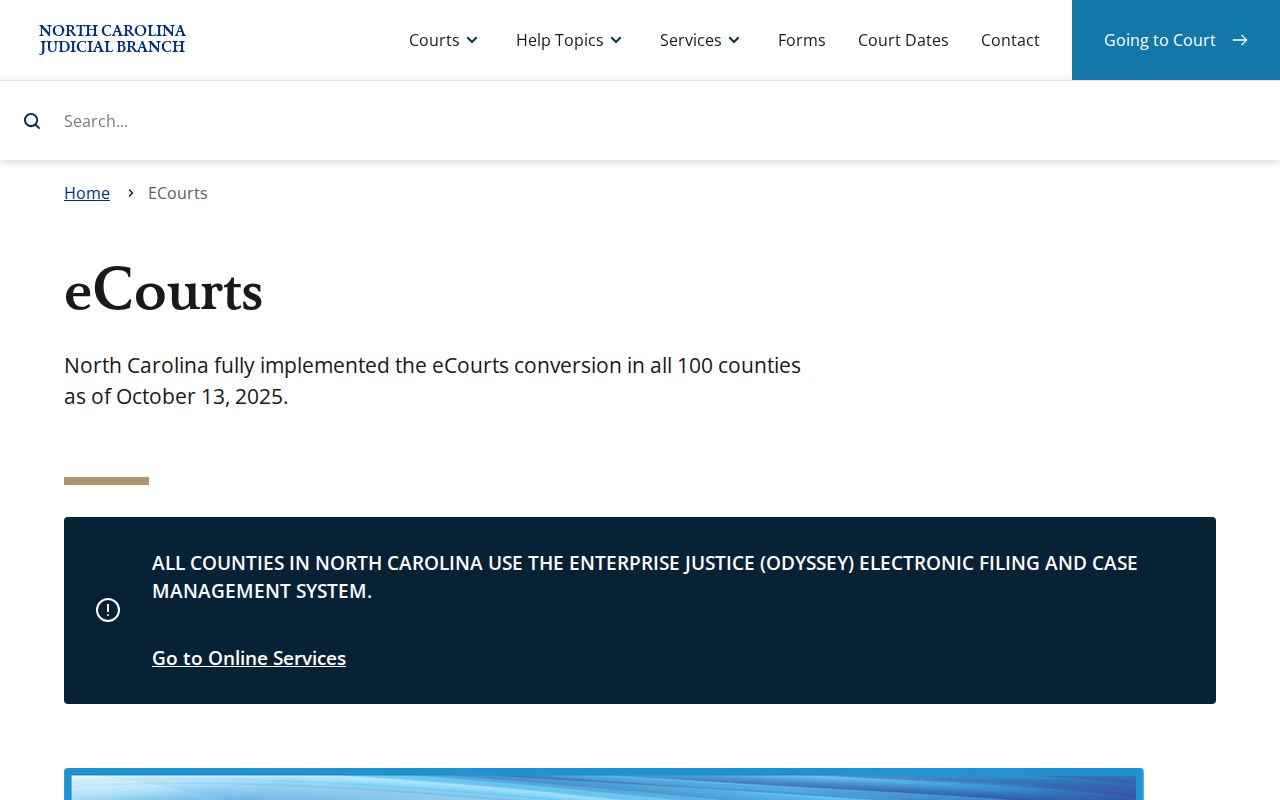
The platform joins Portal, electronic filing, Guide & File, payments, and court workflows, but each tool serves a distinct purpose.
The statewide completion announcement reports the final rollout and agency usage figures.
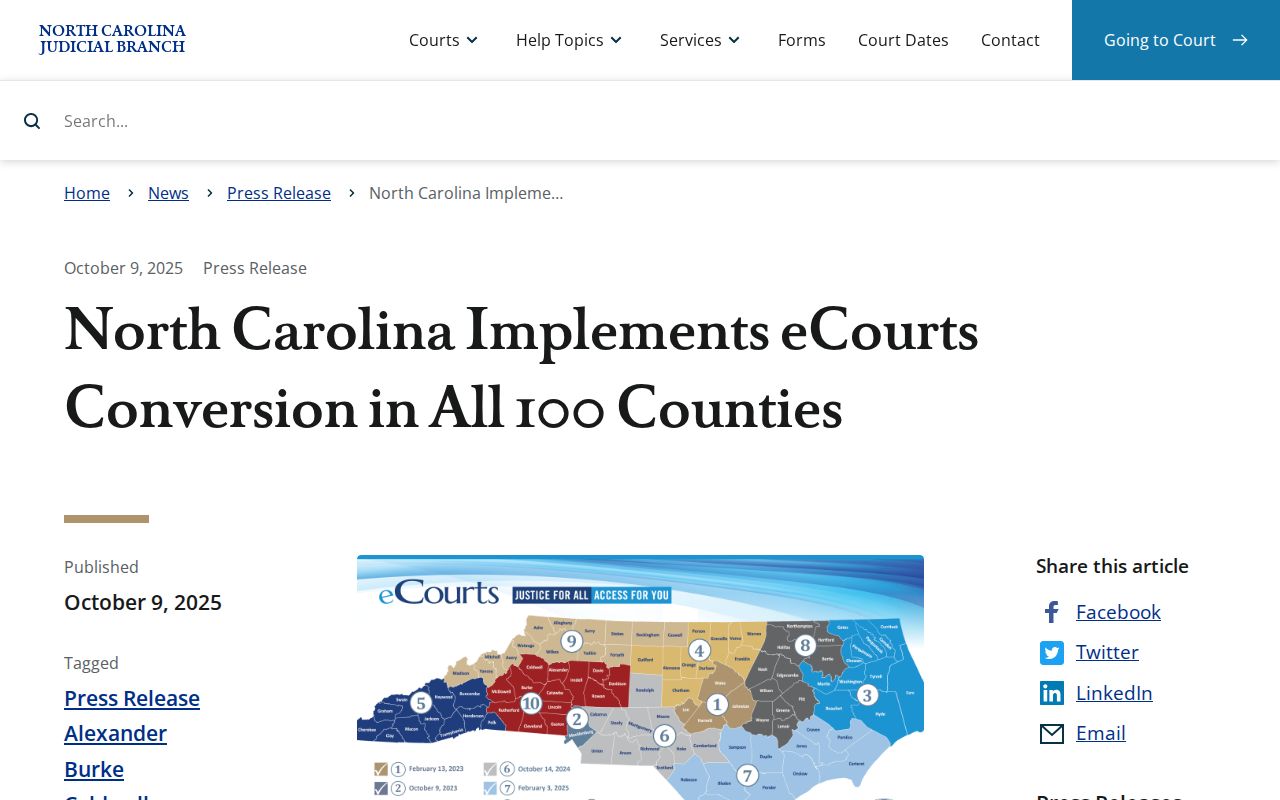
Those figures describe system scale, not a guarantee that every historical page or protected filing can be viewed online.
Earlier final-track training information documents attorney eFiling preparation and migration work.
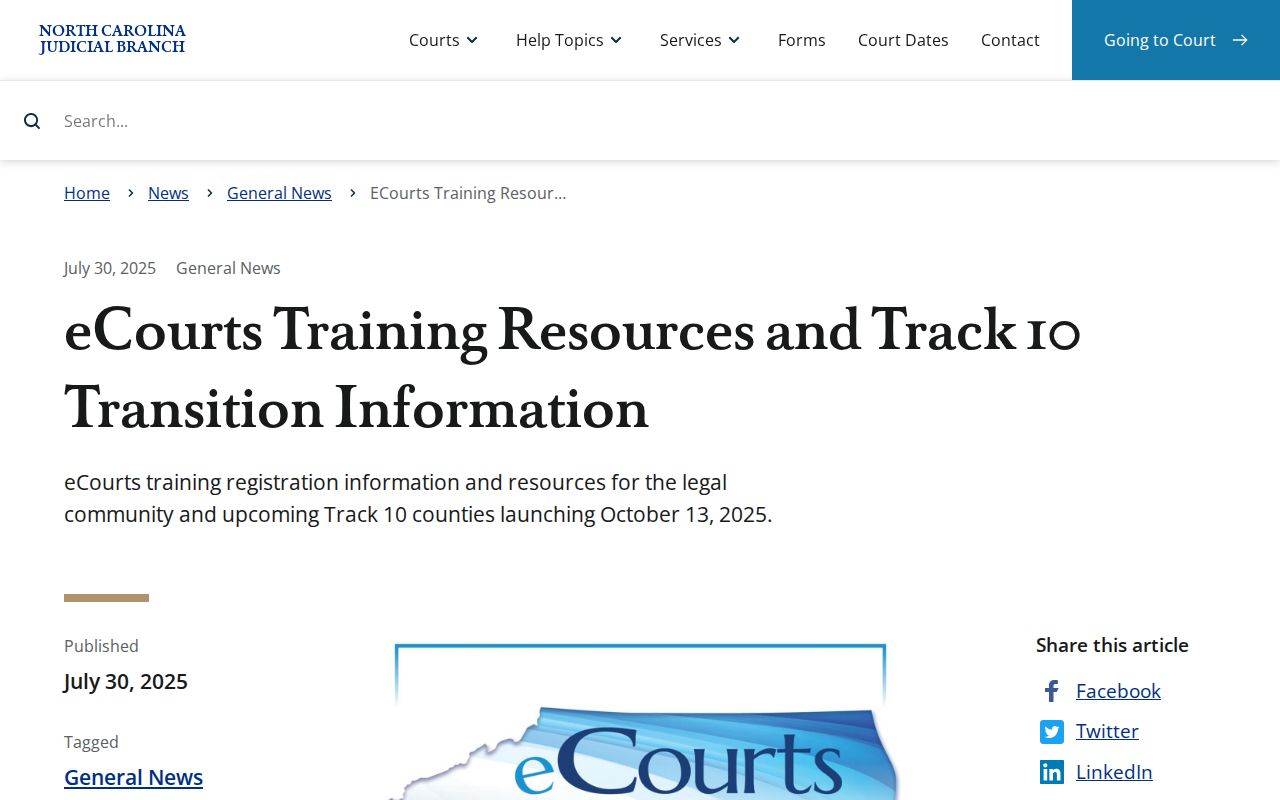
After conversion, these materials remain useful context for understanding legacy depth and electronic filing duties.
The Judicial Branch statewide services directory identifies which tool handles search, filing, forms, records, and payment.
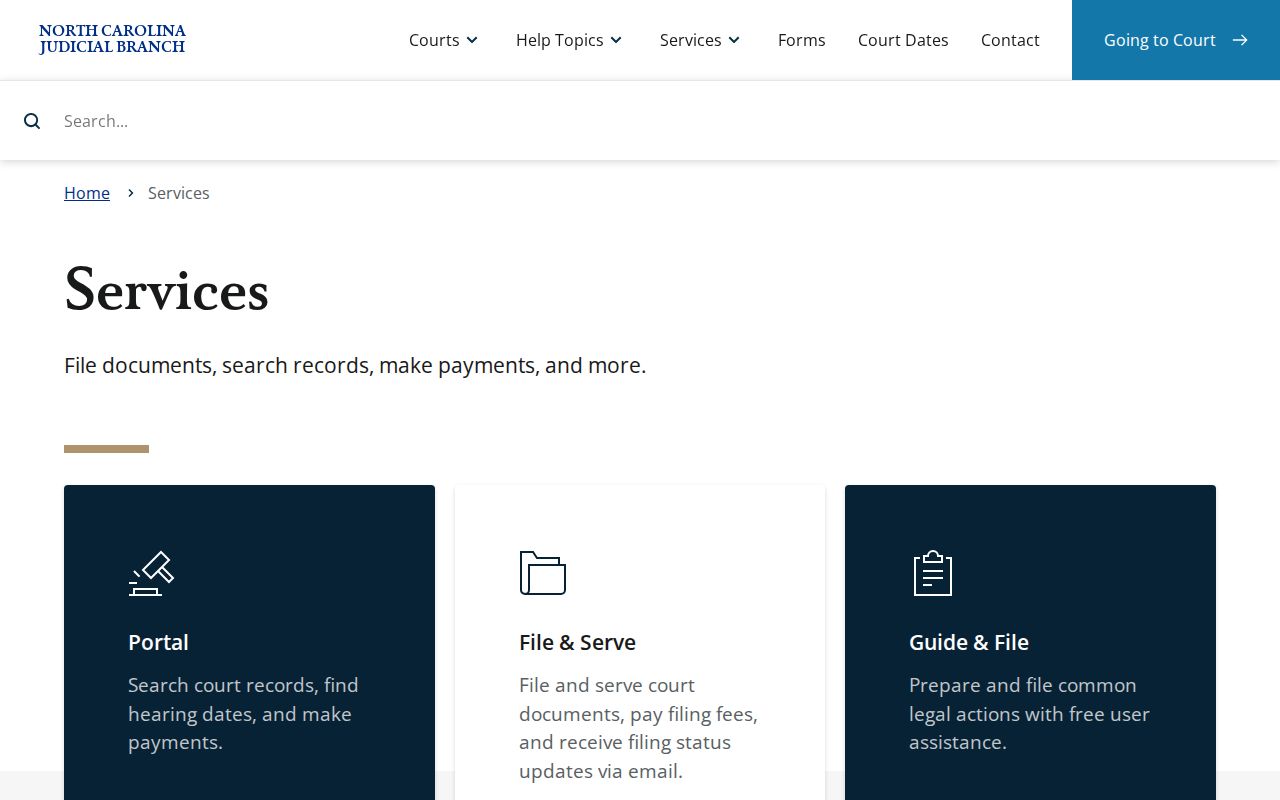
Choosing the correct service avoids sending a county case-document request to the administrative public-record form.
Federal Court Records in North Carolina
Federal court records use a separate system. North Carolina is divided among the Eastern, Middle, and Western U.S. District Courts, with appeals to the U.S. Court of Appeals for the Fourth Circuit. Federal cases are searched through PACER or requested from the relevant federal clerk. They do not appear as state trial cases merely because the courthouse is located in North Carolina.
The Eastern District of North Carolina publishes its federal court information and filing access.
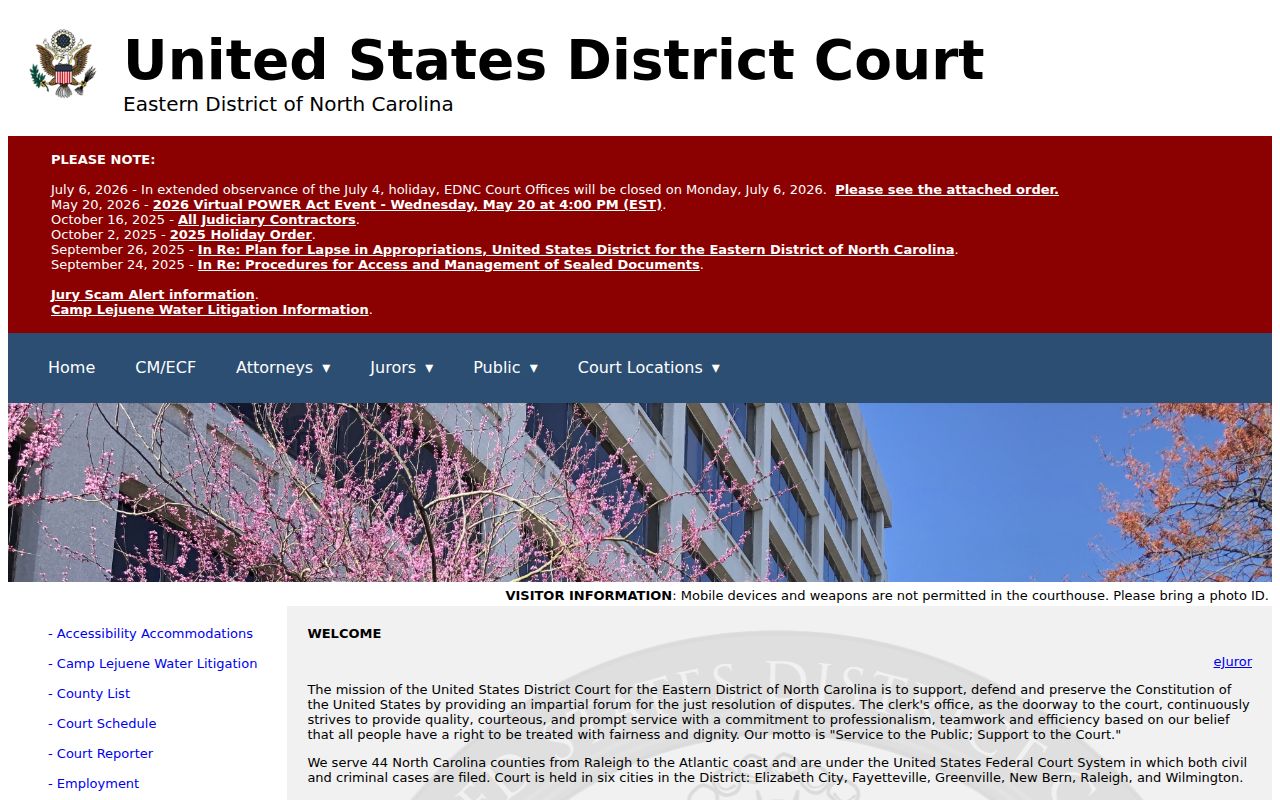
Use the federal case number and district when requesting a filing or certified copy.
The Middle District of North Carolina is a second independent federal trial jurisdiction.
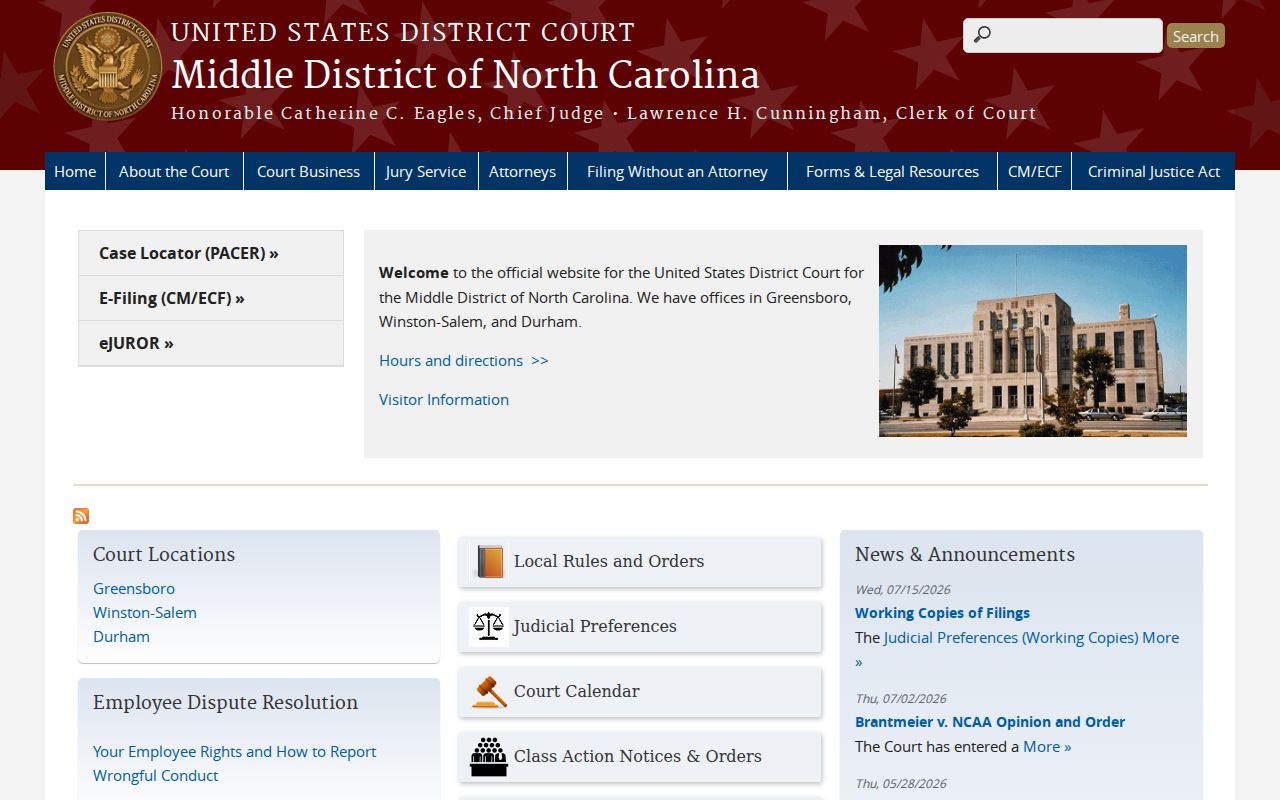
A party's county and the event giving rise to the federal case help determine the proper district.
The Western District of North Carolina supplies the third district's official court services.
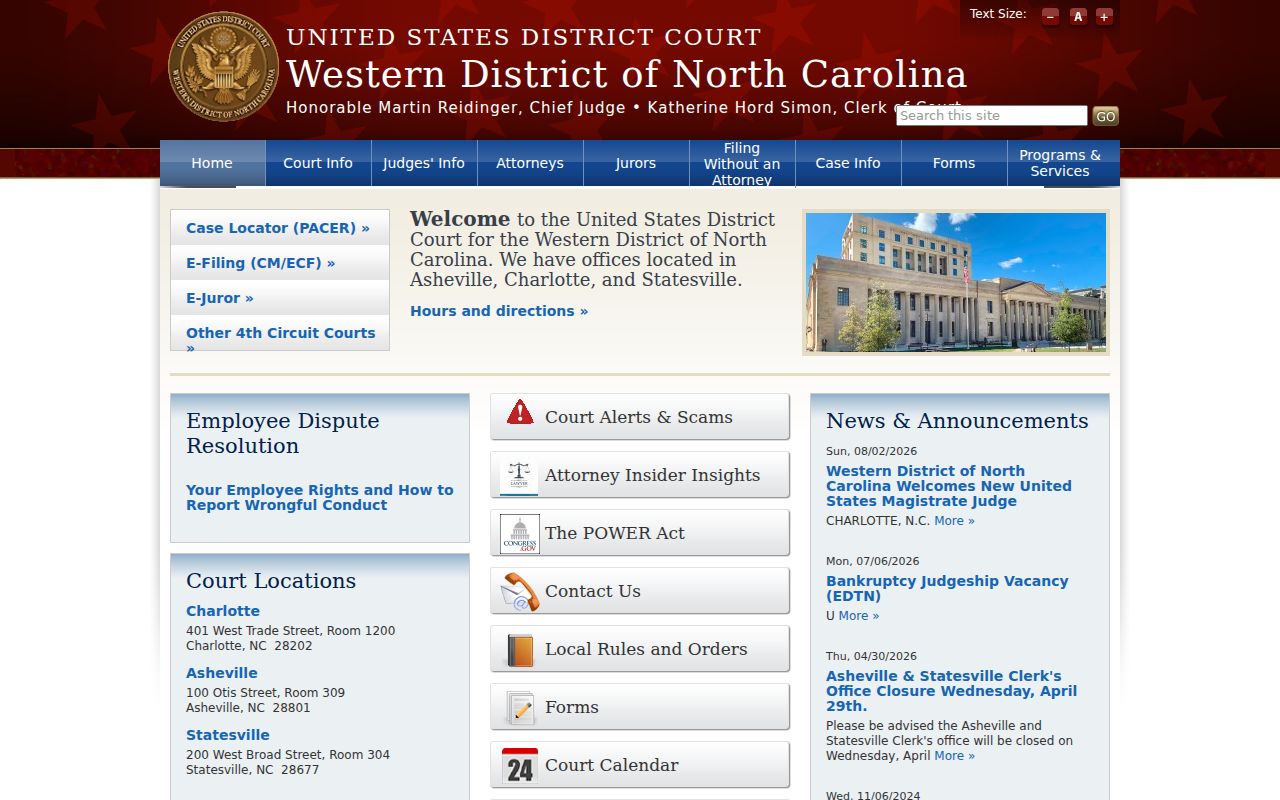
Bankruptcy courts also follow the federal district structure, while state probate remains a Clerk of Superior Court function.
North Carolina Court Records Questions
Can anyone search eCourts Portal?
Anonymous users may search public case information. Registration is optional and adds conveniences such as saved cases. It does not open juvenile, sealed, confidential, or role-restricted information. Elevated access requires verified authority.
Are Portal records official copies?
No. Portal is useful for locating and reviewing public case information. A certified or exemplified copy comes from the Clerk of Superior Court in the county that holds the file.
Why is a document missing?
The item may be paper-only, not migrated, not yet imaged, sealed, confidential, or otherwise protected. Record the case number and ask the county clerk for that specific document instead of assuming the entire case is closed.
Does one clerk handle both trial courts?
Yes. North Carolina uses a unified clerk structure. The elected Clerk of Superior Court in each county maintains both Superior Court and District Court records and also acts as judge of probate.
Where are marriage and divorce records kept?
The county Register of Deeds handles marriage licenses and local marriage certificates. The Clerk of Superior Court keeps divorce case files and judgments. North Carolina Vital Records supplies eligible certificates within its holdings.
Can court records be used for a background check?
Portal is not the official background-check product. A county clerk search and the SBI's authorized criminal-history routes have different scope. This privately operated site is not a consumer reporting agency, and its information cannot be used for an FCRA-regulated decision.