
North Carolina Arrest Records and Charges
North Carolina arrest records document a seizure or booking by law enforcement. They may identify the person, arresting agency, intake time, initial allegation, bond, and booking number. Those facts are held by the arresting agency or county sheriff. A court charge record begins when criminal process or an accusation enters the General Court of Justice. A magistrate may issue process and set release conditions, while the district attorney controls prosecution in District and Superior Court.
The distinction matters. A jail roster can repeat the officer's intake charge before screening. Portal can later show reduced, added, consolidated, superseding, or dismissed counts. The booking side appears with county inmate records; the complete procedural outcome belongs in the criminal court case file. Neither an arrest nor a filed accusation is a conviction.
The arrest-to-charge path can begin without a custodial booking. An officer may issue a citation for an appropriate traffic or low-level offense. After a warrantless arrest, the accused is presented promptly to a magistrate, who addresses probable cause and release. Felonies often begin in District Court for first appearance and probable-cause handling. A grand jury true bill later supplies the Superior Court indictment unless a lawful alternative applies. Separate counts and file numbers can arise from one arrest.
Keep the document names precise. An arrest warrant authorizes custody, a criminal summons commands appearance without immediate arrest, and an indictment records the grand jury's accusation. None proves guilt. The final judgment, read with every charge-level disposition, supplies the outcome.
Search North Carolina Arrest Records
Start with the official agency that created the record. A county sheriff or police department holds the arrest report and booking data. The statewide eCourts Portal shows public court charges and later case events for all 100 counties. The county Clerk of Superior Court keeps the original court file. Use the North Carolina county directory when the arrest county is known.
- Identify the arrest county, arresting agency, booking date, and name used at intake.
- Search that sheriff's official roster or request its existing arrest or booking record.
- Search eCourts Portal by defendant name, file number, or citation and filter by county.
- Open each case and read every charge sequence, statute, level, status, and disposition.
- Ask the county clerk for a certified charging paper or judgment when formal proof is required.
Ask the law-enforcement agency for public portions of its report. Active investigative content may be withheld, and public-record access is not the same as a defendant's discovery rights. A missing Portal match can result from spelling, a different file number, confidentiality, expunction, or legacy limits. Confirm uncertainty with the clerk rather than treating silence as proof.
For a reliable chronology, write down the booking allegation first. Then locate the Portal file, follow each charge through every status change, and obtain a certified judgment when legal proof matters. The Judicial Branch public-record form is meant for administrative records held by the courts or NCAOC. It does not bypass the county clerk for case documents, and it cannot force an agency to build a new compilation.
North Carolina Charging Documents
North Carolina uses several criminal-process documents, not one universal complaint. A citation can direct a person to answer an offense without booking. After a warrantless arrest, a magistrate's order states probable cause and charges. A judicial official may issue an arrest warrant or criminal summons on a sworn showing. Felonies commonly reach Superior Court through an indictment. An information is available only when North Carolina law and waiver requirements permit it.
| Document type | Created by | What it does |
|---|---|---|
| Complaint or magistrate's order | Sworn complainant or magistrate after warrantless arrest | States alleged facts, probable cause, and initial counts. |
| Information | Prosecutor | Files a formal accusation only in a qualifying context with required waiver or consent. |
| Indictment | Grand jury | A true bill formally accuses approved felony counts for Superior Court. |
Read North Carolina Charge Status
Read status at the count level. One arrest can lead to several file numbers and several allegations, each with a different result. “Disposed” says only that an item ended. It does not identify the outcome. Compare the filed charge, any superseding accusation, the disposition, and the judgment.
| Status | What It Means |
|---|---|
| Pending | No final charge-level result is recorded. |
| Amended or reduced | The accusation changed; inspect the new statute, class, and count. |
| Dismissed | The charge ended without a guilty adjudication, subject to the exact entry. |
| Nolle prosequi | The prosecutor formally chose not to proceed at that time. |
| No true bill | The grand jury did not return the proposed accusation. |
| Guilty or not guilty | A plea or adjudication resolved the charge; read the judgment or verdict. |
North Carolina Charges vs. Convictions
Probable cause can support arrest or process. Conviction requires a guilty plea accepted by the court or an adjudicated guilty result. Public access does not erase that difference. North Carolina charge records may remain visible after dismissal or acquittal unless an expunction or other restriction applies.
| Charge | Conviction | |
|---|---|---|
| Stage | Accusation | Verdict or plea |
| Meaning | Accusation | Adjudicated guilt |
| Source | Process or charging document | Plea and judgment or verdict and judgment |
| Correct reading | Use “charged with” or “accused of” | Confirm the final count and sentence |
North Carolina Sealed vs. Expunged Records
Sealing restricts public inspection while the record remains held. Expunction gives qualifying records the removal, destruction, or confidential treatment directed by statute. North Carolina eligibility varies for dismissals, not-guilty outcomes, eligible convictions, juvenile matters, identity theft, and other categories. A petition uses the matching AOC form and is filed in the county of charge or conviction.
The broad public-record definition appears in G.S. 132-1, but specific confidentiality and expunction rules control. The linked official statute provides the public-law context.
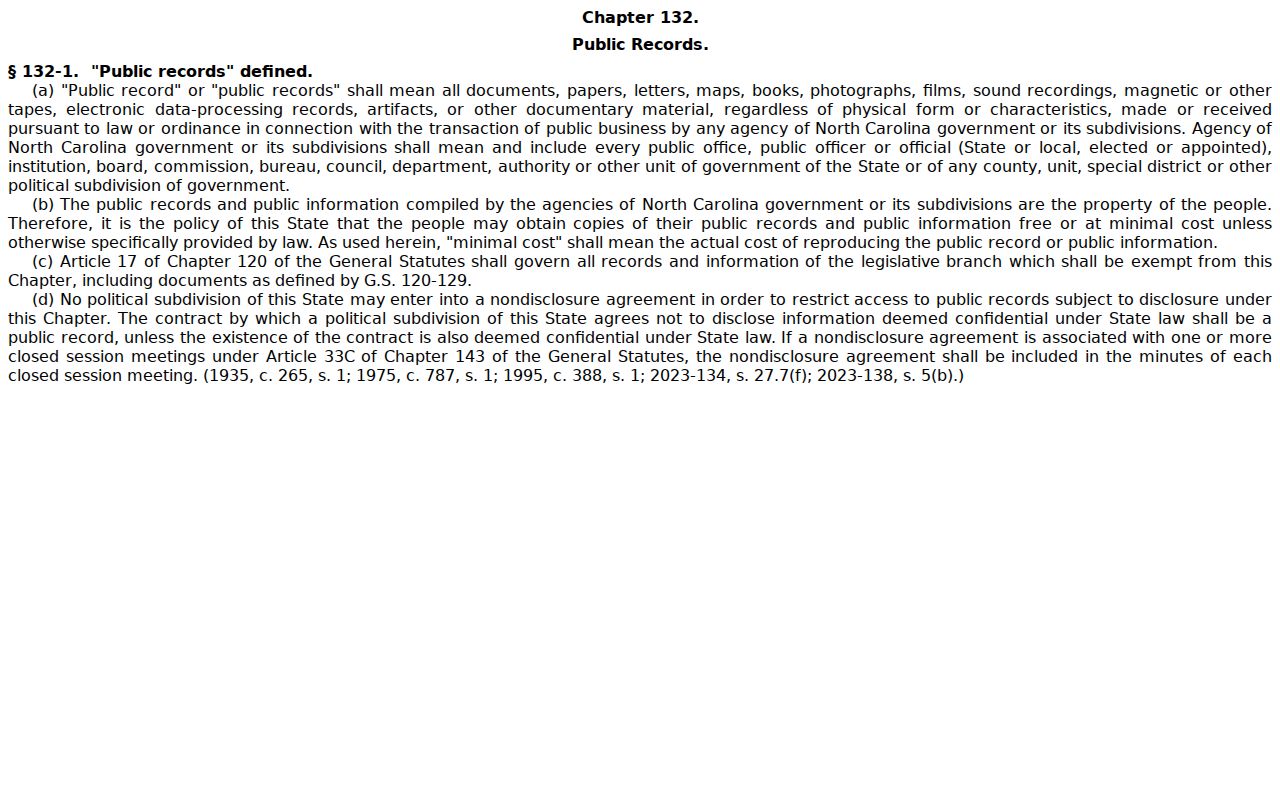
A public-record definition never overrides a valid seal, expunction, juvenile restriction, or protected-data rule.
| Sealed | Expunged | |
|---|---|---|
| Public view | Hidden as ordered or required | Removed from ordinary public searches |
| Record status | Retained with restricted access | Treated according to the applicable expunction statute |
| How obtained | Specific law or judicial order | Qualifying petition and court order |
North Carolina Charge Codes
A Portal charge can display its sequence, offense description, North Carolina General Statute, offense date, and felony, misdemeanor, or infraction class. Felony classes run A through I. Misdemeanor levels include A1 and Classes 1 through 3. Class is not the result or sentence. District Court retains misdemeanors and infractions; felony matters usually begin there and proceed to Superior Court by indictment or another lawful path. The same Clerk of Superior Court keeps both divisions' records.
North Carolina Statewide Charge History
The North Carolina SBI computerized criminal history is a fingerprint-supported repository. A subject's Right to Review searches North Carolina arrests supported by fingerprints and associated dispositions received by SBI. The $14 request requires identity data, official fingerprints, and the stated payment form. It is not a public name lookup, not a national history, and not the complete county pleading file.
Use the SBI response to spot statewide events, then compare each disputed or incomplete entry with the certified judgment from the county clerk. A disposition may be absent if the reporting agency did not link it. Routine employer or licensing checks require statutory authority and an access agreement. Third-party consumer screening is also governed by federal FCRA duties.
The Right to Review form calls for complete name and mailing address, race, sex, date of birth, signature, official fingerprint certification, and rolled and plain impressions. A Social Security number is voluntary. SBI requires a certified check or money order and returns poor or incomplete fingerprints. The separate FBI Identity History Summary is a federal product and does not replace the North Carolina court file.
North Carolina Records and Public Access
G.S. 132-6 provides reasonable inspection and copying of public records, subject to lawful restrictions and fees. The official statute illustrates those rights.
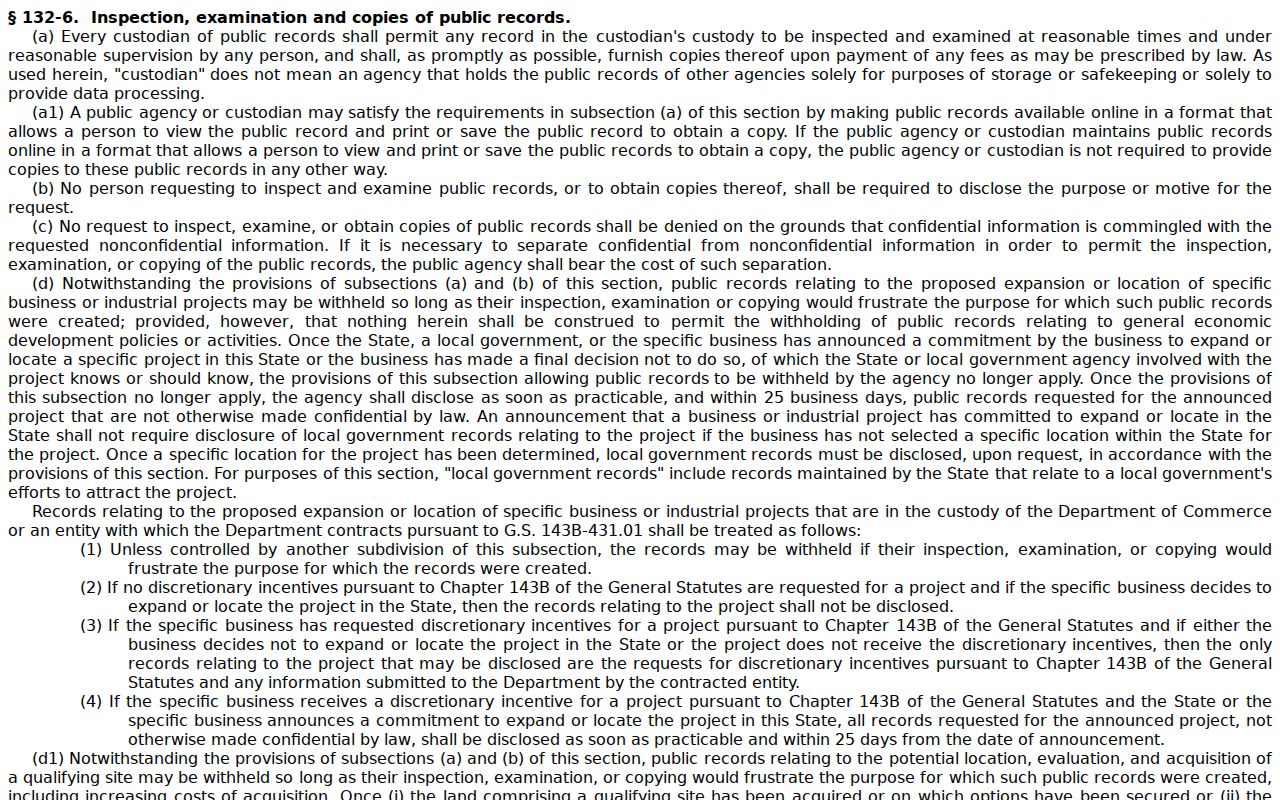
Direct a request to the actual custodian. Sheriffs hold booking data, police hold incident material, clerks hold filed charges, and SBI holds the compiled fingerprint history. An office need not create a new statewide report.
Important: This site is not a consumer reporting agency, so its information cannot support employment, housing, credit, or other FCRA decisions.
Restricted North Carolina Charge Records
Juvenile files, adoption matters, involuntary-commitment records, sealed documents, expunged cases, protected identities, and some investigative material are not open through ordinary search. Public copies may redact Social Security numbers, financial accounts, full birth dates, health facts, protected addresses, and minor or victim information. A docket can show that an order exists while its image remains blocked.
Dismissal does not itself make a public case vanish. North Carolina's expunction routes depend on the event and statute, and processing can take months while agencies complete checks and the court schedules any needed hearing. If an order is granted, the clerk distributes it to the agencies named by law. A confidential state index may remain for limited statutory purposes, and private copies made before the order are not necessarily erased.
The North Carolina Sex Offender and Public Protection Registry is a separate public system, not a general arrest or criminal-history database.
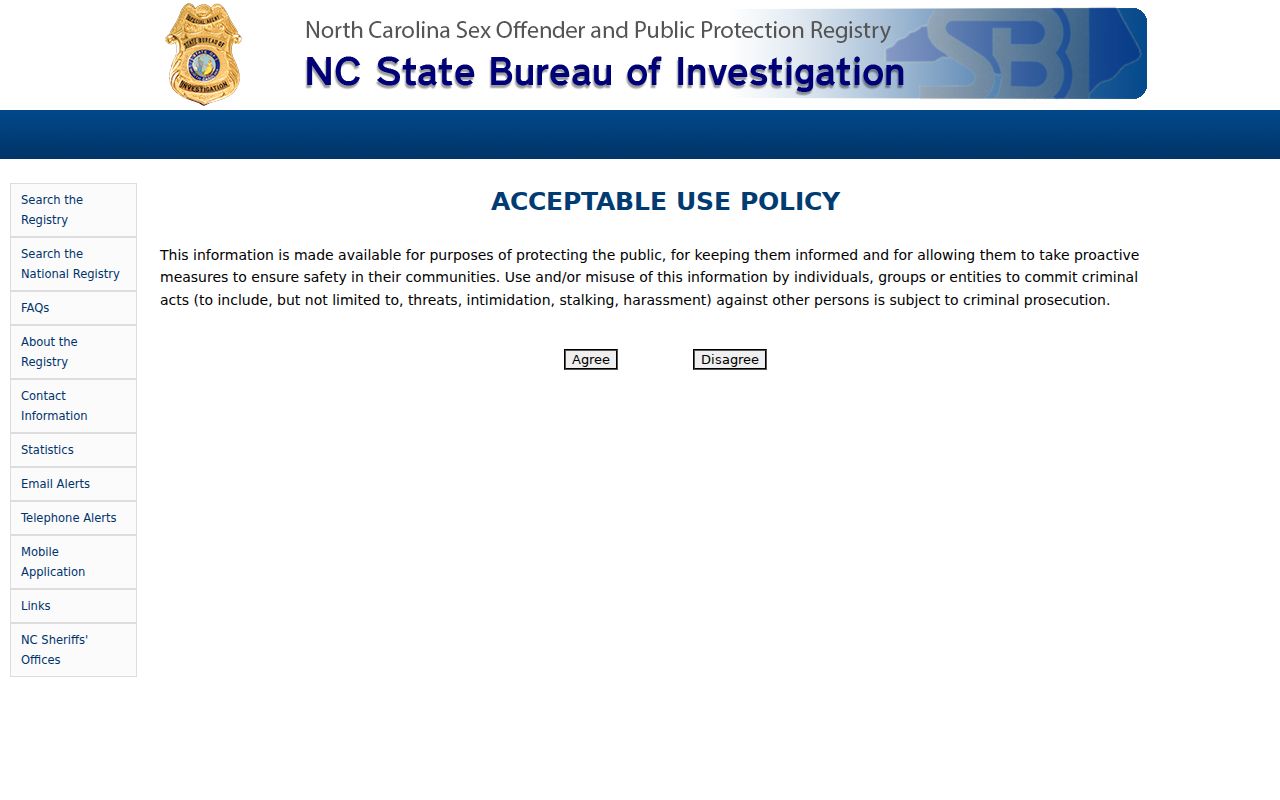
Registry status should never be inferred from a charge search. Use the registry's official identity and location fields for its limited statutory purpose.