
North Carolina's Unified Clerk Structure
Each county has one elected Clerk of Superior Court. That clerk maintains court files for both trial divisions, receives money, supports courtroom operations, and performs statutory judicial duties. North Carolina does not have a separate District Clerk, county-court clerk, or municipal-court clerk. The North Carolina Administrative Office of the Courts, or NCAOC, supplies statewide systems and recordkeeping rules, while the elected county office remains the physical and legal custodian of its files.
Clerks are chosen in partisan elections for four-year terms. Deputies and assistants vary with local workload. The unified model does not merge every public record into the clerk office. Registers of Deeds hold marriage and land instruments. Sheriffs and police hold incident, booking, and agency records. District attorneys maintain prosecution files rather than the neutral court file.
North Carolina Clerk of Superior Court
The Clerk of Superior Court holds felony and higher-value civil files from Superior Court. The office also keeps District Court criminal, traffic, civil, domestic, and juvenile indexes, subject to confidentiality rules. Judgments, liens, estates, and special proceedings also fall within its portfolio. Public case information may appear in eCourts Portal, but the clerk supplies official copies and handles paper or archived material that is not online.
- Superior Court felony and civil case files
- District Court misdemeanor, traffic, civil, domestic, and public index records
- Judgments, liens, dockets, and public court documents
- Estates, probate, guardianships, trusts, and special proceedings
- Plain, certified, and exemplified copies of court records
The Judicial Branch court-officials overview describes clerk duties and selection. Its official page appears below.
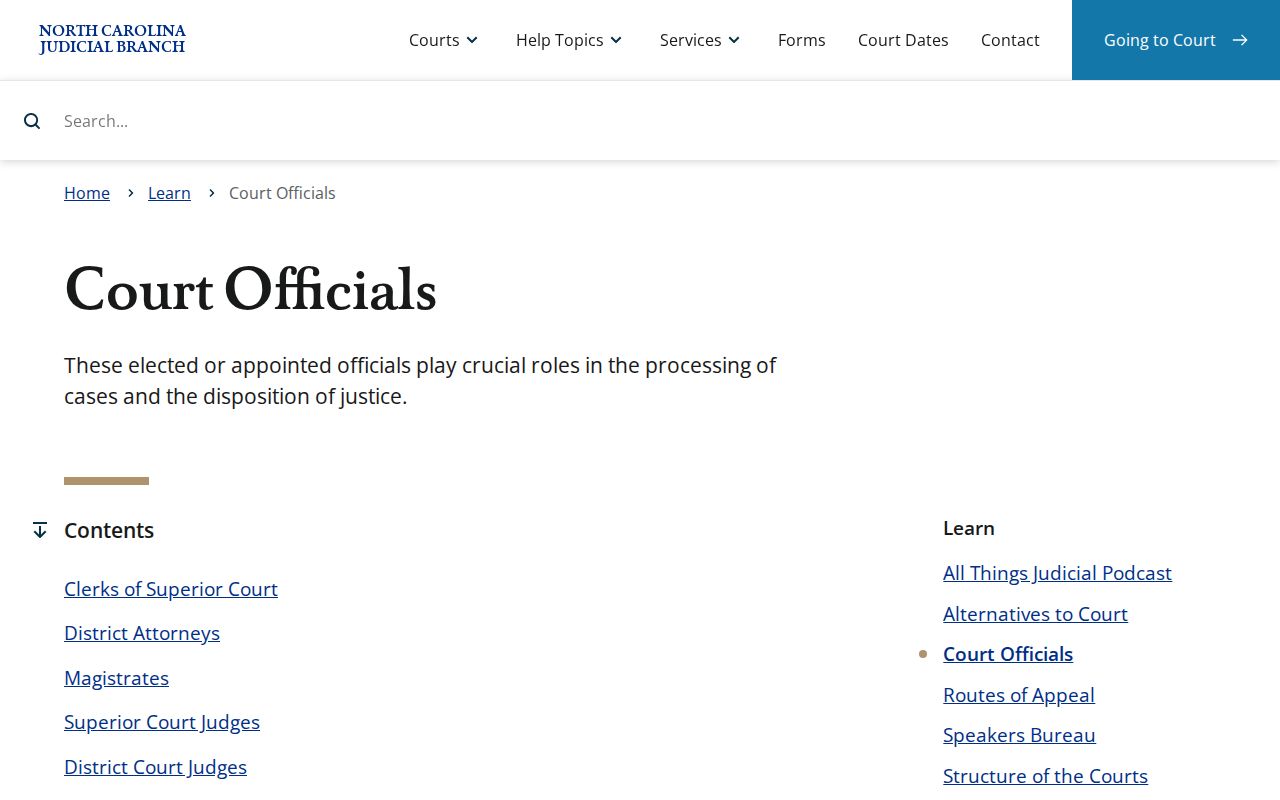
The clerk's combined administrative and judicial authority explains why one county office can keep trial files and also decide probate matters.
North Carolina Clerk Records and Duties
The unified clerk office is the destination for trial-court records, but its role changes with the file. In a civil or criminal case, the clerk receives filings and maintains the docket. In probate and authorized special proceedings, the clerk also acts in a judicial capacity. Noncourt record systems remain with the agency that created them.
| Record / Case Type | Clerk of Superior Court Role |
|---|---|
| Felony criminal cases | Keeps Superior Court filings, docket entries, judgments, and public documents |
| Misdemeanor and traffic cases | Keeps District Court records and eligible payment information |
| Civil and family cases | Keeps Superior and District Court pleadings, orders, judgments, and indexes |
| Probate, estates, and guardianships | Keeps the file and exercises judicial authority as provided by law |
| Marriage licenses and deeds | Not the custodian; contact the county Register of Deeds |
| Incident, arrest, and jail records | Not the custodian; contact the sheriff or police agency |
What North Carolina Court Clerks Do
Clerks accept pleadings, assign or maintain case numbers, preserve the official file and docket, issue process, receive statutory fees and case payments, and authenticate copies. They support Enterprise Justice and the courthouse's public terminals. Under G.S. 7A-109, prescribed files, dockets, indexes, judgments, and related records are open during regular office hours unless law prohibits inspection.
- Accept filings and maintain the official case number
- Preserve the docket, documents, judgments, and public indexes
- Issue summonses, notices, writs, and other authorized process
- Receive and account for filing fees, fines, costs, and eligible payments
- Provide plain, certified, and exemplified copies
- Administer estates and decide authorized special proceedings
Clerk staff may identify forms, locate records, explain office procedure, and state the charge for a service. They cannot select a legal claim, interpret an order for a party, calculate a filing deadline, or recommend which expunction statute applies.
Request North Carolina Certified Copies
A certified copy carries the clerk's authentication and may be required by another court, agency, bank, or title office. Portal information is not certified. The request must go to the Clerk of Superior Court in the county where the case or estate file is held. An exemplified copy provides a more specialized authentication and should be requested only when the receiving body requires it.
- Find the filing county through the county directory and select its Clerk of Superior Court.
- Gather the case number, party names, approximate filing date, and exact document title.
- Ask whether the office accepts the request at the counter, by mail, or by a division-specific email.
- Confirm the copy type, total charge, payment method, and mailing requirement.
- Review the delivered document to ensure the requested pages and certification are present.
Pre-conversion and archived records may take longer to retrieve. A representative county pattern uses Portal for available electronic documents and division email or counter requests for older content. The official example appears below.
View an official North Carolina county record-access example.
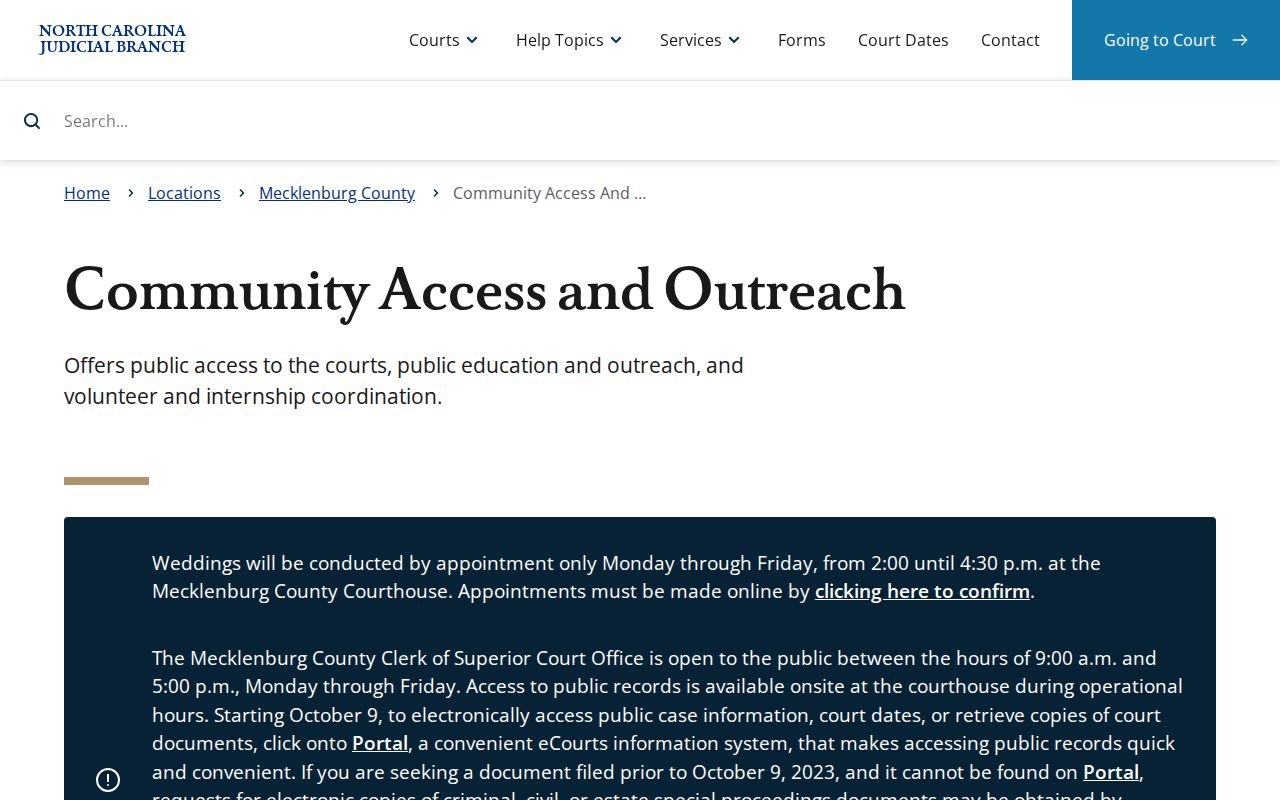
The same broad rule applies statewide: Portal helps locate a record, while the filing county resolves missing or official documents.
North Carolina Record Request Fields
A focused request reduces delay and prevents the clerk from guessing which document is wanted. Statewide administrative requests use the Judicial Branch form, but case-document requests belong with the county clerk. Email, mail, phone, and counter practices vary, so confirm the local method before sending payment.
| Field | Required | Notes |
|---|---|---|
| Case number | If known | Fastest way to identify the file |
| Party or estate names | Yes | Provide complete names and both sides when possible |
| Filing or event date | Approximate | Narrows a name search and helps archive retrieval |
| Document requested | Yes | Name the judgment, order, indictment, will, or other filing |
| Copy and authentication type | Yes | State plain, certified, or exemplified and the number of copies |
| Delivery details | As needed | Requester name, mailing address, email, and phone for follow-up |
North Carolina Clerk Fees
The General Assembly sets judicial costs, primarily through Chapter 7A Article 28, and the courts publish current charts. Rather than freezing an amount that may change, confirm the exact service in the 2026 court-cost publications. Page count, certification, exemplification, postage, archive work, case type, service, and payment method can affect the total.
| Item | Amount |
|---|---|
| Plain, certified, and exemplified copies | See current Miscellaneous Costs chart |
| Record searches and recordings | See current Miscellaneous Costs chart |
| Civil and divorce filing | See current Civil Costs chart; service and case components may add |
| Estate administration | See current Estates chart; procedure and estate value can affect total |
| Guardianship, foreclosure, and special proceedings | See current Special Proceedings chart |
| Criminal and traffic costs | See current Criminal chart and annual waiver lists |
Noncriminal filing costs are generally advanced when the case begins, including sheriff service where required. Later motions, hearings, publication, a guardian ad litem, a bond, a transcript, or certified copies can add charges. Criminal and traffic judgments may combine court costs with a fine, restitution, appointed-counsel reimbursement, probation or community-service charges, and other statutory items. The clerk applies these components but does not set an independent county base fee.
A person who cannot advance filing costs may submit the statewide Petition to Proceed as an Indigent. Approval addresses the advance-payment requirement under the governing rules, but it does not promise that every later expense disappears. Legal-services clients can qualify under specific provisions. Ask the county clerk for the current form and filing procedure, while recognizing that staff cannot decide eligibility or provide legal advice.
North Carolina Clerk Forms
The Judicial Branch services hub links statewide forms, Guide & File, Portal, File & Serve, payments, and other services. Guide & File uses guided interviews to prepare documents for supported matters, while filing fees still apply. County-specific instructions should be checked through the county directory.
- Guide & File interviews for supported divorce, probate, guardianship, expunction verification, small claims, and traffic matters
- Court record instructions for civil, criminal, estate, divorce, and transcript access
- Court cost information for charts, payment, waivers, and failure-to-comply rules
North Carolina Mail and E-Filing
All counties use Enterprise Justice. eCourts Portal provides public case information, while File & Serve handles secure trial-court electronic filing under applicable rules. Attorneys must e-file when the rules require it; options for self-represented people depend on the case. Guide & File prepares supported forms but does not itself erase filing costs. Mail practices and division addresses remain county-specific.
The official court-cost help page is shown below because fees and payment duties are central to both filings and copy requests.
Review North Carolina court costs and payment rules.
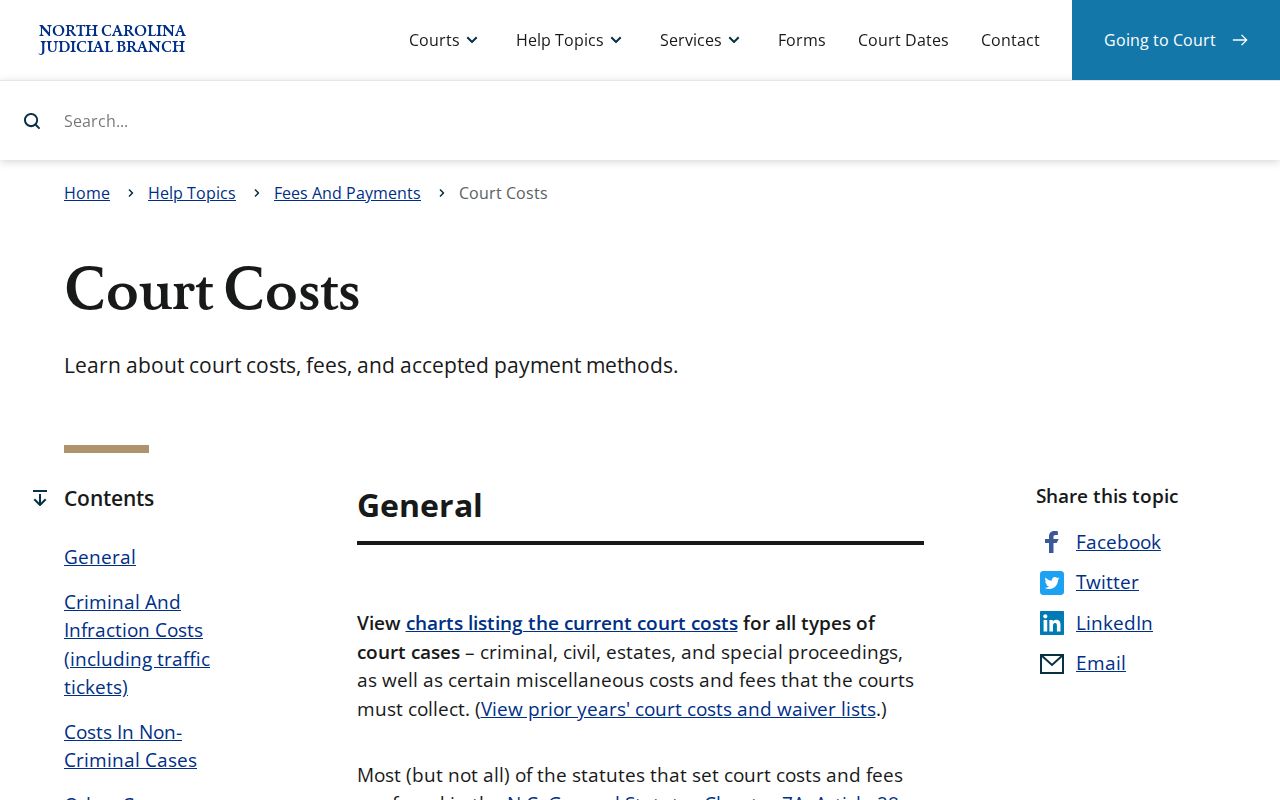
The legislature sets the cost framework, and the clerk applies the live chart to the particular filing or record service.
Find North Carolina County Clerks
Every county has one Clerk of Superior Court. Browse the full directory of all 100 North Carolina counties to reach the right local records site, then confirm official office details through the judiciary's Locations directory. Choose the county of filing, not a party's current home county.
For an original or certified case document, contact the civil, criminal, estate, or special-proceedings section that holds the file. Use Portal first to capture the exact case number and document label. For an administrative NCAOC record, use the Judicial Branch public-record route instead. These channels reflect who created and keeps the requested record.