
North Carolina Offices by Record
Three offices serve different roles. The Register of Deeds in the licensing county holds the marriage application, returned license, and local certified copy. The Clerk of Superior Court in the county that granted a divorce keeps the pleadings, orders, and certified judgment. North Carolina Vital Records maintains statewide certificate data within its holdings and offers eligible certified products. It cannot provide the complete divorce case or the original county marriage instrument.
Quick Reference:
New or original marriage license: Register of Deeds in a North Carolina county.
Certified local marriage copy: Register of Deeds in the issuing county.
Divorce pleadings and judgment: Clerk of Superior Court in the county that granted the divorce.
State certificate product: North Carolina Vital Records, subject to its holdings and eligibility rules.
| Record | Original Issuing / Filing Office | Certified Copy Source |
|---|---|---|
| Marriage license | Register of Deeds in licensing county | Issuing Register of Deeds |
| Recorded marriage instrument | Register of Deeds after officiant return | Register of Deeds or available Vital Records product |
| Divorce petition and case file | Clerk of Superior Court in filing county | That county clerk |
| Divorce judgment | Clerk of Superior Court in granting county | County clerk or available Vital Records product |
North Carolina Marriage Licenses
Any North Carolina Register of Deeds may issue a license that generally authorizes a ceremony anywhere in the state. Local appointments and online preapplications differ. Both applicants ordinarily provide identity, age, and Social Security information or a lawful alternative. The office may ask for records tied to an earlier marriage or name. Applicants under 18 face narrow rules and should confirm eligibility directly.
North Carolina ordinarily has no waiting period or premarital blood test, and a license is generally valid for 60 days. Confirm current terms with the issuing Register before travel. An authorized religious officiant or magistrate may conduct the ceremony. The officiant must return the completed license to the issuing Register for recording.
Apply for a North Carolina License
Choose an issuing county based on its current appointment and appearance process. The county directory routes to every local records site. Review the Register's live instructions before gathering documents.
- Select a Register of Deeds and complete its preapplication if offered.
- Bring the identity, age, and prior-marriage documents the office requires.
- Appear and swear or affirm the application as instructed.
- Pay the current marriage-license fee to the Register.
- Have an authorized person perform the ceremony while the license is valid.
- Ensure the officiant returns the signed instrument to the issuing Register.
- Order certified local copies after recording when legal proof is needed.
Marriage License Application Fields
County web forms vary, but North Carolina marriage applications collect core identity, residence, family, prior-marriage, and vital-statistics data. Social Security numbers and other protected fields are not ordinary public display data. The live county form controls what is required.
| Field | Required | Notes |
|---|---|---|
| Full legal names | Yes | Names before marriage, including suffixes. |
| Residence and birth data | Yes | Address, date and place of birth. |
| Social Security number | Generally, if assigned | Protected; a statutory alternative may apply. |
| Parents and vital statistics | As form requires | Parent names and birthplaces may be collected. |
| Prior marriages | Yes | Number, how the last ended, and date. |
| Oath and signatures | Yes | Completed before an authorized official as required. |
North Carolina Record Fees
Use the live custodian schedule. Marriage-license and local certified-copy prices come from the issuing Register of Deeds. Civil divorce filing and court-copy costs follow the current North Carolina court-cost charts, with service and case-specific items added. Vital Records publishes its own certificate fees, while an online vendor may add shipping or expedited charges.
| Item | Amount | Where Paid |
|---|---|---|
| Marriage license | Confirm current county amount | Register of Deeds |
| Certified local marriage copy | Confirm copy schedule | Issuing Register of Deeds |
| Civil or divorce filing | See current Civil Costs chart | Clerk of Superior Court |
| Certified divorce judgment | See current Miscellaneous Costs chart | Granting county clerk |
| Vital certificate | Confirm live order page | North Carolina Vital Records |
Search North Carolina Marriage Records
For the recorded license image or original local application, contact the Register of Deeds in the licensing county. Provide both names, the approximate event date, and the county. Many counties offer index tools, but a search result is only an access aid. The Register supplies the authoritative local copy. Older material may require archive or State Archives research rather than a current digital index.
For an available statewide product, use the official Vital Records order channel. The office searches within its own holdings and product rules. Do not describe the statewide certificate as the original license. The North Carolina Vital Records overview presents that distinction:
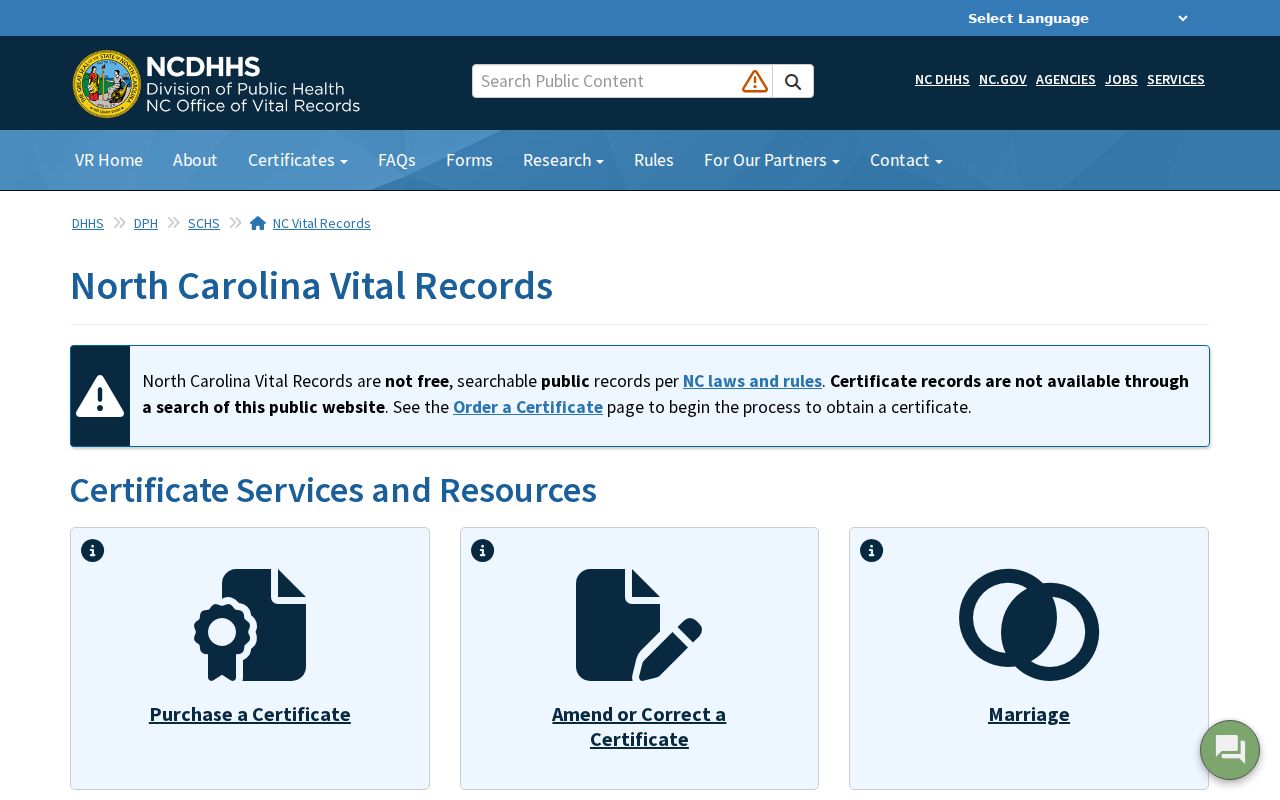
The image identifies the statewide route, while the county Register remains the correct source for the original marriage instrument.
Find North Carolina Divorce Records
Search eCourts Portal with either spouse's name and the likely county or case type. Public results may show filing date, parties, hearings, and a judgment event. Domestic files can contain restricted material, so not every image is public online. The Clerk of Superior Court in the county that granted the divorce provides the authoritative judgment and full public case file. Older files may be archived on paper.
The official divorce and marriage help topic also provides forms and process information:
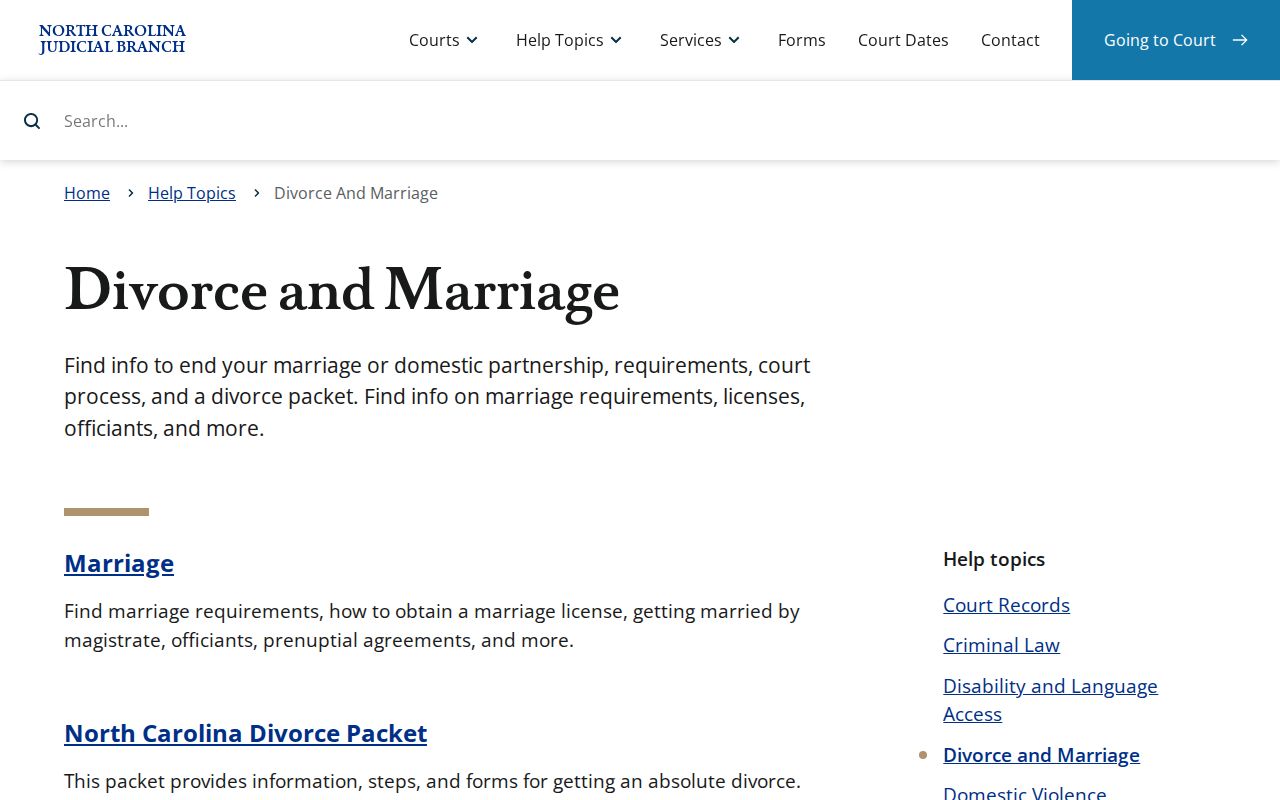
Use that statewide court resource for the case process, then request the decree from the clerk in the granting county.
North Carolina absolute divorce generally rests on living separate and apart for at least one year with intent that separation be permanent, plus at least six months of state residence by one spouse before filing. Service is required. Property division and alimony claims can be lost if not raised before judgment, so a basic form path is not right for every family.
A typical filing includes a complaint, civil summons, domestic civil action cover sheet, and any other state or local forms that apply. The filer pays the current civil and service costs or submits a Petition to Proceed as an Indigent. The other spouse must be served through a lawful method; handing the papers over personally is not valid service. A defendant normally has 30 days after service to answer, subject to extensions and court rules. Hearing and judgment scheduling then follows the county's procedure or the applicable eFiling process.
Custody and child support remain distinct claims. An annulment also is not a faster name for divorce; it concerns a marriage that is legally void or voidable on specific grounds. North Carolina does not create new common-law marriages within the state, though a marriage validly created elsewhere may be recognized. These distinctions affect which case record exists and what document a requester should ask the clerk to certify.
Getting Certified Copies
Choose the copy by its intended use. The Register certifies a recorded marriage instrument. The Clerk of Superior Court certifies a divorce judgment or another public filing. Vital Records supplies the certificate products it offers within its holdings. An agency requesting proof may specify which one it accepts.
- Identify whether the recipient needs the local original, court judgment, or state certificate.
- Gather both names, event year, county, and the requester's relationship.
- Use the correct county custodian or the official Vital Records order channel.
- Submit identification and eligibility proof when the product requires them.
- Follow the current payment, delivery, and pickup instructions.
The official certificate order page displays the available request channels:
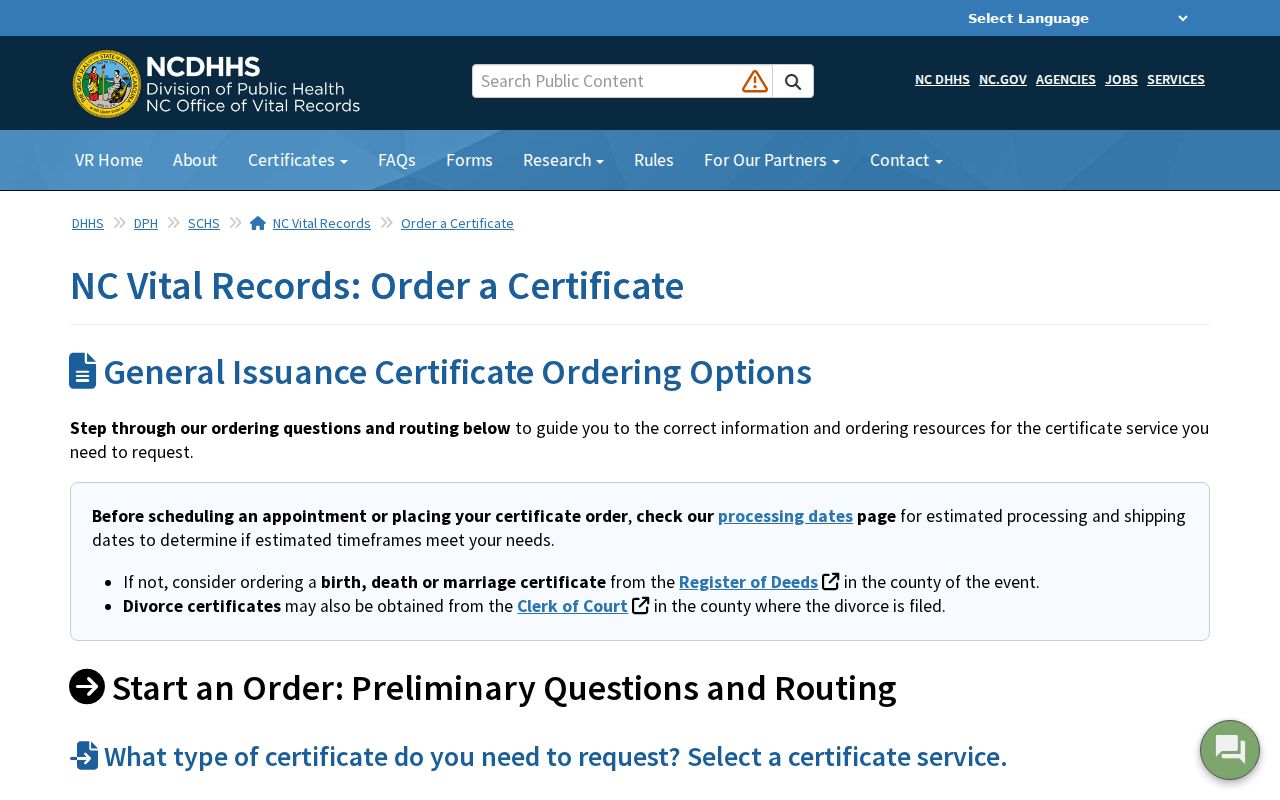
Check that live page for current identification, fees, vendor charges, appointment rules, and delivery choices.
North Carolina Vital Records Office
North Carolina Vital Records is the statewide certificate office for events within its holdings. Its order process may offer an authorized online vendor, mail, and appointment or in-person service. The form requests the record type, people named, event date and county, requester identity and relationship, purpose when required, copy type, payment, and delivery details. The office's holdings and eligibility rules determine whether it can issue the requested product.
A state certificate is not the full divorce litigation file. It also is not the original marriage application held by the Register of Deeds. Restricted certificate requests can require accepted identification and proof of relationship or legal authority. Genealogy research may need the county Register of Deeds or State Archives.
Vital Records vs. county office: Vital Records issues its statewide products. The Register holds the original marriage instrument, and the Clerk of Superior Court holds the full divorce file.
North Carolina Vital Records
Statewide marriage and divorce certificate products
Online, mail, and currently offered appointment channels
Route North Carolina County Records
Marriage licenses come from a Register of Deeds, while divorce cases go to the unified Clerk of Superior Court. Use the full North Carolina county directory to reach the event county. Give the office names, both parties' names, approximate date, and known file or license number. That precise request helps staff locate archived paper and quote the correct certification charge.
Guide & File offers a supported absolute-divorce interview and other document-preparation tools:
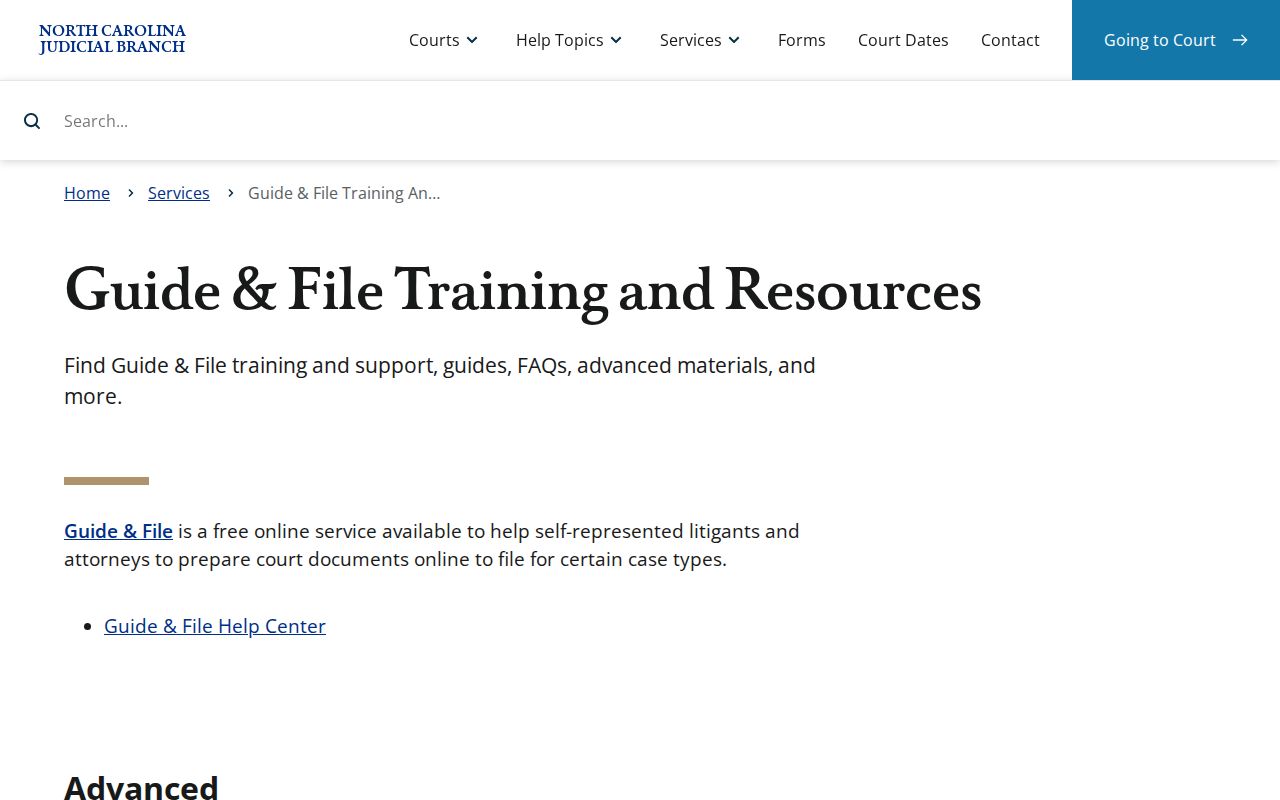
The interview prepares forms but does not file them, serve the other party, remove court costs, or replace legal advice.