
Search North Carolina Traffic Records
Traffic charges in North Carolina are filed in District Court in the county named on the citation. The official Citation Services entry point connects eligible tickets to online search, payment, dismissal, or reduction tools. The statewide eCourts Portal can also locate cases by citation number. Online choices depend on the offense and case status. If no action appears, contact the Clerk of Superior Court in the charging county. A blank online option does not cancel the court date.
Start with the exact citation number. A party name, county, and printed court date help confirm the match. North Carolina has no municipal or justice-of-the-peace traffic court layer, so ordinary state and local traffic charges belong in District Court. The county clerk remains the source for paper archives, documents missing online, and certified dispositions.
- Open Citation Services or eCourts Portal and copy the citation number exactly.
- Use county and party name when a number search does not return a clear match.
- Compare the charge and court date with the paper citation before acting.
- Review whether payment, dismissal, or reduction is offered. Eligibility is case-specific.
- Ask the county clerk for a certified disposition or an older document that is not imaged.
North Carolina Traffic Case Venue
District Court handles North Carolina infractions, traffic misdemeanors, and ordinary ordinance cases. Magistrates may accept some waivers or guilty pleas, but they operate within District Court. Serious conduct such as impaired driving remains a criminal District Court case and can also trigger an administrative license action. Superior Court may hear a qualifying appeal for trial de novo. It is not the first filing office for an ordinary ticket.
This unified structure matters when a citation names a town or was issued by city police. The issuing agency does not create a separate municipal court. Search the District Court case in the county of citation and use that county's Clerk of Superior Court for the official file.
| Court Level | Traffic Cases Handled | Where to Find |
|---|---|---|
| District Court | Infractions, traffic misdemeanors, DWI, and ordinary ordinance charges | eCourts Portal or county Clerk of Superior Court |
| Magistrate | Acceptance of certain waivers and pleas within District Court authority | County court location and clerk instructions |
| Superior Court | Qualifying appeals for a new trial | Unified county Clerk of Superior Court |
North Carolina Traffic Case Types
North Carolina traffic records may concern a waivable infraction, a charge that requires appearance, or a criminal motor-vehicle offense. The annual waiver list and the live case determine whether online payment is allowed. Paying a waivable charge gives up the contest and is treated as guilty or responsible as charged. A pending request for reduction or compliance dismissal does not excuse attendance unless the system or court confirms resolution.
- Waivable violations: eligible charges may be resolved without a hearing, but the waiver has conviction or responsibility effects.
- Compliance matters: some equipment or documentation charges may qualify for an online dismissal request.
- Serious charges: DWI, reckless or high-speed allegations, and many CDL matters can require appearance.
- Failure events: a missed date or unpaid judgment can create court fees and NCDMV consequences.
- Camera and crash records: local camera notices and law-enforcement crash reports are distinct records whose current custodian must be checked.
What North Carolina Traffic Records Show
A North Carolina court traffic record tracks the filed accusation and the court's response. It can show a matter before NCDMV receives any final report. The Register of Actions is a timeline, not a substitute for each filed paper. For proof of the final result, request the judgment or certified disposition from the clerk.
| Field | What It Shows |
|---|---|
| Citation number | The exact identifier printed on the ticket and used for direct matching. |
| Charge and statute | The filed allegation; it is not proof of guilt. |
| County and court date | The venue and scheduled appearance, subject to later court changes. |
| Plea and disposition | Waiver, guilty, responsible, dismissal, reduction, or another count-level result. |
| Fine and costs | Financial terms assessed in the court case. |
| FTA or FTC event | A failure to appear or failure to comply event that may be reported to NCDMV. |
North Carolina Citation Search Fields
The citation number is the best direct key. A name search can return several people, while the county and date help rule out a false match. Newly filed data may take time to appear. Confirm a doubtful result with the county clerk rather than assuming the case has vanished.
| Search Field | Type | Required | Notes / Format |
|---|---|---|---|
| Citation Number | Text | Preferred | Copy the ticket exactly. |
| County | Dropdown | Conditional | Select the charging county. |
| Defendant or party name | Text | Alternate | Use the legal spelling. |
| Court date | Date | Optional | Use as a confirmation point. |
| Pay, dismissal, reduction | Action | Conditional | Only appears when eligible. |
Resolve North Carolina Traffic Tickets
The official traffic violations instructions explain waiver, contest, payment, failure events, and license effects. Eligible tickets may be paid online, at the counter, or by mail before court. Online payment uses a card. A mailed waiver must be signed and sent with a certified check, cashier's check, or money order payable to the Clerk of Superior Court. Do not mail cash or a personal check.
To contest a charge, appear in District Court in the charging county or determine whether counsel may appear. The State must prove the allegation. Online reduction and compliance-dismissal requests require eligibility and supporting documents. A submission alone does not extend a deadline.
- Read the county, charge, court date, and appearance terms.
- Confirm the case in Citation Services or Portal.
- Review license and insurance effects before waiving the charge.
- Submit an eligible online request, pay by an approved channel, or appear to contest.
- After disposition, verify the case and obtain a certified clerk copy if needed.
The Judicial Branch notes that international network traffic may be blocked. Inability to reach the site from abroad does not change the deadline.
North Carolina Traffic Record Access
G.S. 7A-109 makes clerk files and indexes open except where law bars access. G.S. 132-6 governs inspection and copies of public records at reasonable times, with lawful exclusions and fees. Driver records are different. The federal Driver's Privacy Protection Act and state rules restrict disclosure of personal data, especially when someone seeks another person's history.
Key Statutes:
Court case information and NCDMV personal information follow different disclosure rules. Access to one does not grant access to the other.
North Carolina NCDMV Driving Records
The North Carolina Division of Motor Vehicles driving-record service supplies certified and noncertified license histories. These products may show license status, reported convictions, points, suspensions, revocations, and administrative actions. They do not contain the court's pleading, prosecutor notes, or hearing transcript.
A county court sends a reportable final result to NCDMV. NCDMV then applies motor-vehicle law and updates its own file. That sequence can create a reporting lag, so a court disposition may appear before the state driver history changes. DMV points and insurance points are also separate systems.
The NCDMV request asks for the subject's name, date of birth, driver license number when known, product type, and payment. A third-party request must identify a permissible DPPA purpose and may require consent. Available products include certified, full, three-year, seven-year, and address histories. Online availability differs by product.
The NCDMV driving-record page illustrates the state file separately from the citation:
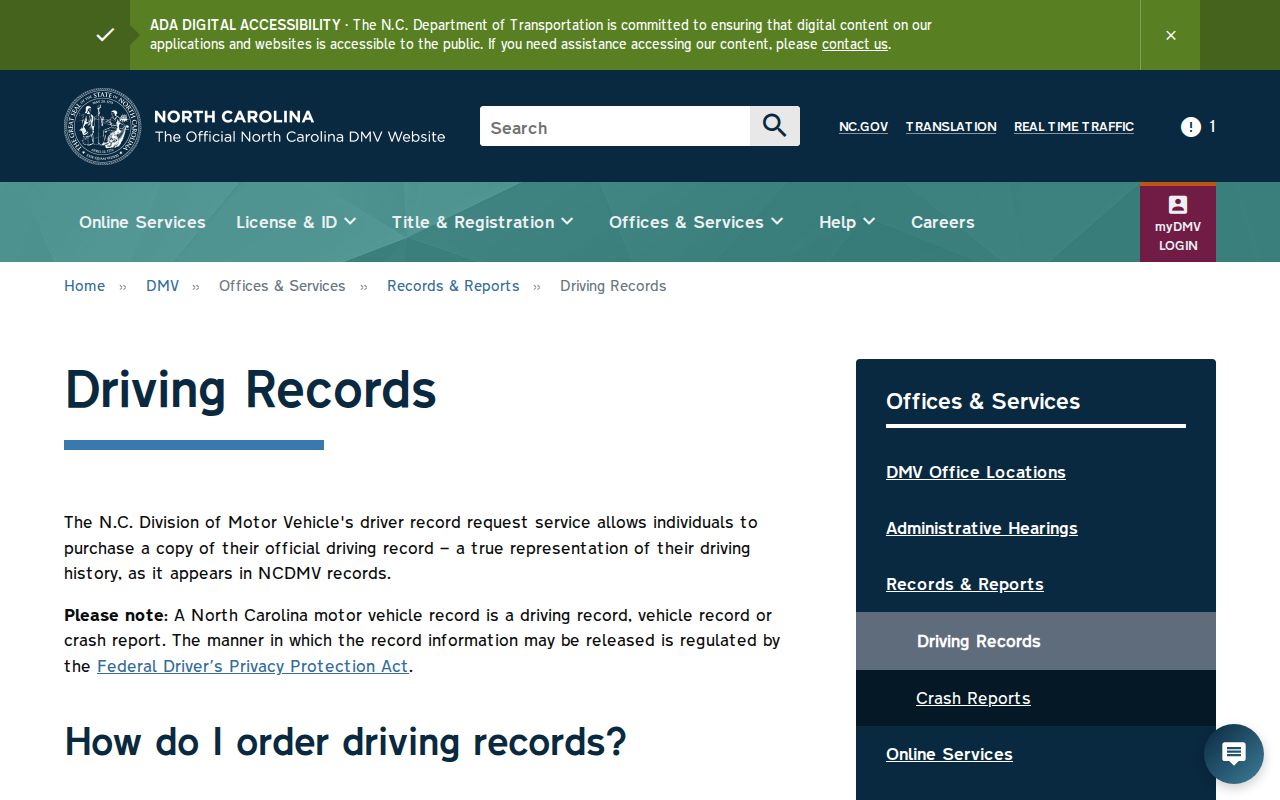
Use that state product to check license history, then return to the county clerk for the underlying North Carolina traffic case.
North Carolina Court vs Driver Record
The court record answers what was charged and what District Court did. The NCDMV file answers what the licensing agency has recorded and the present license effect. Corrections must go to the custodian that owns the error. A wrong court disposition belongs with the clerk; a driver-history posting issue belongs with NCDMV, often supported by a certified disposition.
| Record Type | Source | What It Shows | How to Access |
|---|---|---|---|
| Court traffic record | County Clerk of Superior Court | Pending charge, dates, plea, disposition, fine, and costs | Portal, Citation Services, terminal, or clerk request |
| North Carolina driver record | NCDMV | Reported convictions, points, status, suspensions, and administrative actions | MyNCDMV or official record request |
North Carolina CDL Traffic Records
Commercial drivers face federal and state reporting rules in addition to ordinary North Carolina consequences. Do not assume a reduction, prayer for judgment continued, or driving course avoids a CDL effect. The court result and NCDMV action must be checked separately. A driver whose job depends on a CDL should review the exact charge and reporting rule before entering a waiver.
North Carolina DWI Court Records
Driving while impaired is a criminal District Court case, not a minor administrative ticket. The case record can show charge events, release terms, hearings, disposition, and judgment. NCDMV may impose a separate administrative license action on its own timetable. For the allegation and filing path, see North Carolina arrest and charge records.
The North Carolina Judicial Branch traffic page shows the statewide court guidance:
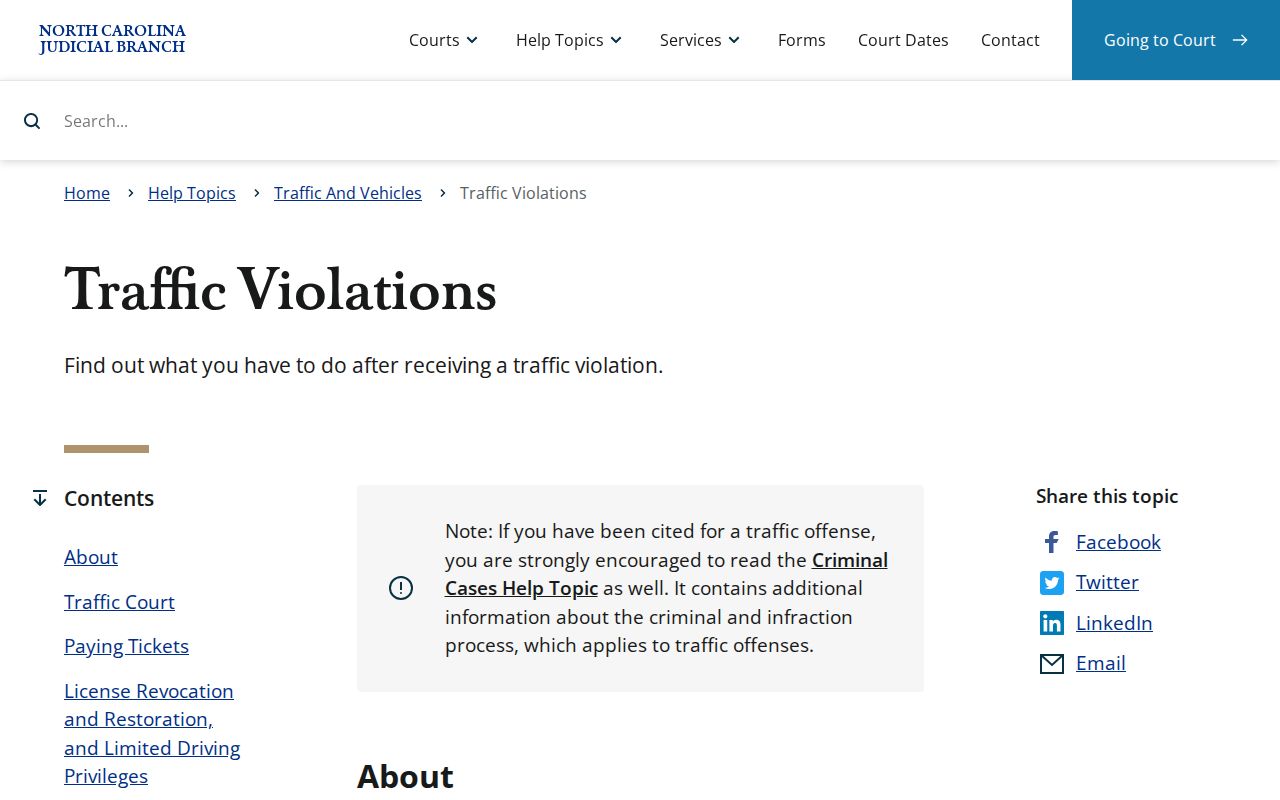
Read the court guidance with the separate NCDMV status record when a license consequence is at issue.
North Carolina Reductions and Relief
North Carolina Citation Services may offer a prosecutor's online reduction or compliance dismissal for an eligible charge. The available option and required proof control. A prayer for judgment continued, course, or negotiated result should not be treated as a universal way to avoid DMV, insurance, or CDL effects. Confirm the final court entry and then verify the driver record.
North Carolina Traffic Expunction Limits
North Carolina expunction depends on the statute, charge, result, age, record, and waiting period. There is no universal motion to hide a traffic case. Even when a qualifying criminal court record is expunged, NCDMV administrative history may remain under separate law. Ask each custodian what the order reaches rather than assuming one order changes both files.
North Carolina Traffic Record Fees
Criminal and traffic court costs depend on the charge, judgment, facilities, and any added FTA or service item. Copy and certification charges come from the current North Carolina court-cost charts. NCDMV products use a separate schedule. Verify the live chart before paying.
| Item | Amount |
|---|---|
| Court copy or certification | See current Miscellaneous Costs chart |
| Certified NCDMV record online | $18 |
| Noncertified full history online | $12.75 |
| Noncertified three-year or seven-year history | $12.75, not online in the official handbook |
| Address history | $16.75, not online; DPPA rules apply |
Missed court dates have separate stakes. After 20 days, an FTA may issue and the unresolved matter may be reported to NCDMV. Failure to pay for 40 days can bring added enforcement, license action, and a civil judgment. Resolving the court case does not itself erase NCDMV restoration terms.
For the local file, choose the charging county in the North Carolina county directory. Every county uses the unified clerk structure, but archive retrieval and request channels can vary.