
North Carolina Court System Overview
The General Court of Justice has Appellate, Superior Court, and District Court divisions. The Supreme Court of North Carolina is the single court of last resort for civil and criminal state-law questions. The North Carolina Court of Appeals is one statewide intermediate court, not a collection of geographic appellate districts. Trial work is divided by jurisdiction between Superior Court and District Court. Magistrates belong to District Court, while Clerks of Superior Court decide probate and specified special proceedings.
Appeal routes vary by case type. Some District Court convictions and small claims judgments receive a new Superior or District Court trial. Many Superior Court and District Court civil or family judgments move to the Court of Appeals on the existing record. The Supreme Court may hear categories reviewable by right and may accept discretionary review. Direct routes exist where constitution or statute provides, so the procedural rules for the specific order control.
Typical appeals path: Magistrate or District Court › Superior Court trial de novo where authorized › North Carolina Court of Appeals › Supreme Court of North Carolina
| Court Level | Court Name | Jurisdiction and Case Types | Number in North Carolina |
|---|---|---|---|
| Court of Last Resort | Supreme Court of North Carolina | Final state-law review, specified direct appeals, discretionary review, and judicial administration | 1 court, 7 justices |
| Intermediate Appellate | North Carolina Court of Appeals | Statewide review of trial records for legal error | 1 court, 15 judges |
| General Trial | Superior Court Division | Felonies, civil disputes over $25,000, Business Court matters, and qualifying de novo appeals | 5 divisions, 48 districts |
| Limited Trial | District Court Division | Misdemeanors, infractions, civil matters at $25,000 or less, family, juvenile, and traffic | Statewide division |
| District Court Officer | Magistrate and Small Claims | Warrants, initial appearances, release conditions, marriages, and small claims generally up to $10,000 | Local assignments statewide |
| Clerk Judicial Role | Clerk of Superior Court | Probate, estates, guardianships, foreclosure, partition, and other authorized special proceedings | 1 elected clerk in each of 100 counties |
Supreme Court of North Carolina
The Supreme Court of North Carolina has seven justices and serves as the final tribunal for state-law issues. It reviews questions assigned directly by law, exercises discretionary review in many Court of Appeals matters, supervises the General Court of Justice, and adopts rules affecting practice and access. Its holdings bind lower North Carolina courts. A qualifying federal constitutional or statutory question may later be presented to the U.S. Supreme Court, but there is no further state appeal.
North Carolina has no separate high criminal court. Civil and criminal review share the same appellate structure. The official Supreme Court profile shown below provides source context for its jurisdiction, sessions, opinions, and history.
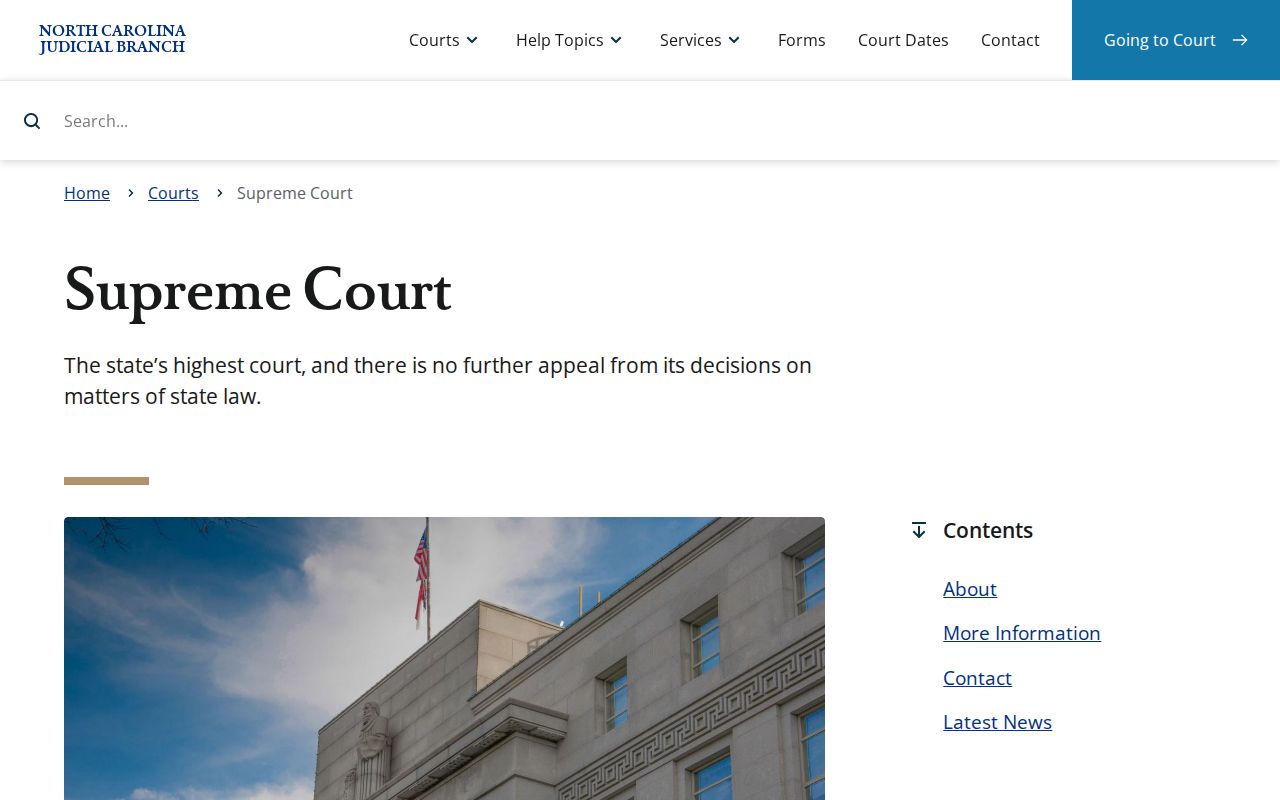
The single-high-court model distinguishes North Carolina from states that divide final civil and criminal review between two courts.
North Carolina Court of Appeals
The North Carolina Court of Appeals has 15 judges serving statewide, ordinarily in five panels of three. It is not divided into geographic districts. The judges review the trial record for legal error and do not retry witnesses or receive a new body of evidence. Its docket includes civil, criminal, juvenile, family, administrative, and other appeals assigned by law.
The official Court of Appeals overview appears in the image below.
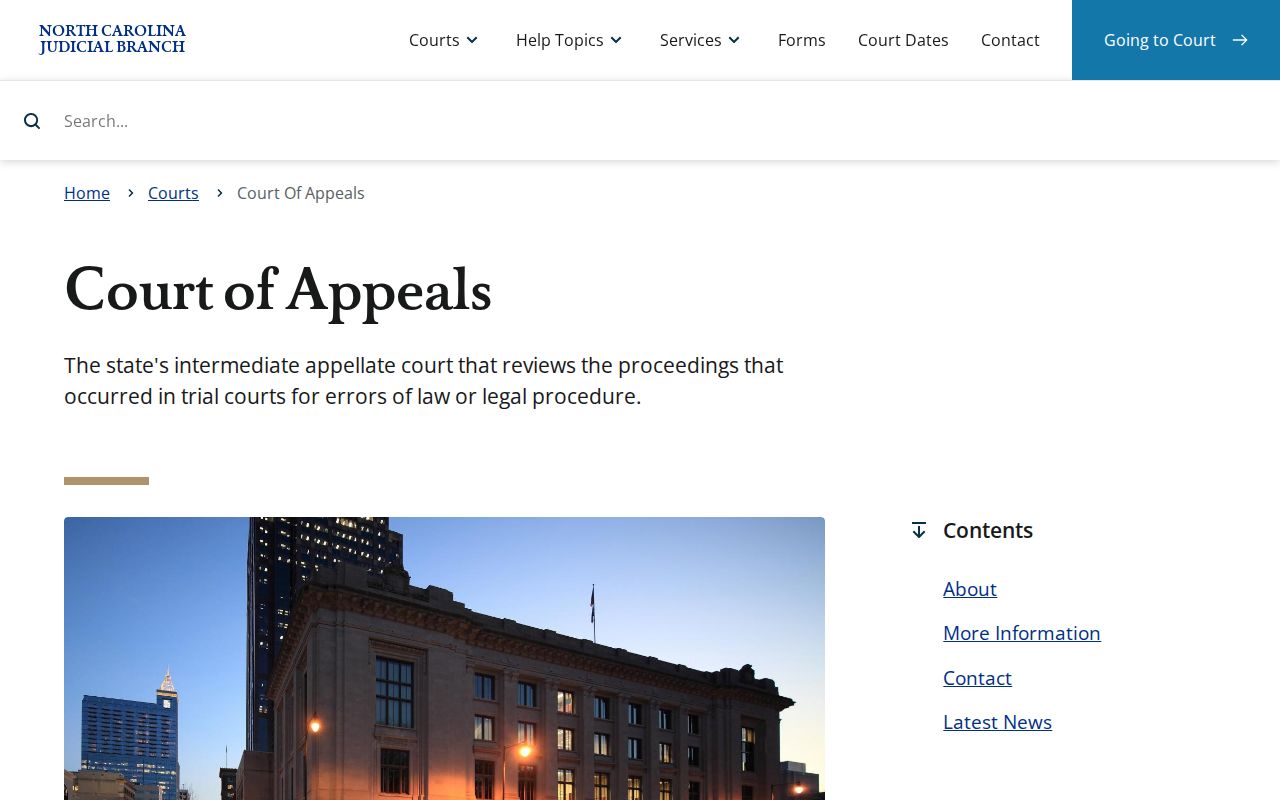
Because every panel serves statewide, a trial county does not select a separate geographic appellate court.
North Carolina Superior Court Division
Superior Court is the general-jurisdiction trial division. It hears felonies, civil controversies over $25,000, and District Court appeals that receive a new trial where law permits. Complex corporate and commercial cases may be designated to the Business Court, which remains a specialized Superior Court forum tied to an originating county file.
Superior Court is organized into five divisions and 48 districts. Resident judges rotate every six months among districts within a division, a constitutional practice meant to reduce local conflicts. Each administrative district has a senior resident judge who manages operations. The county Clerk of Superior Court keeps the file even when a rotating judge hears the matter.
The official Superior Court profile is shown below.
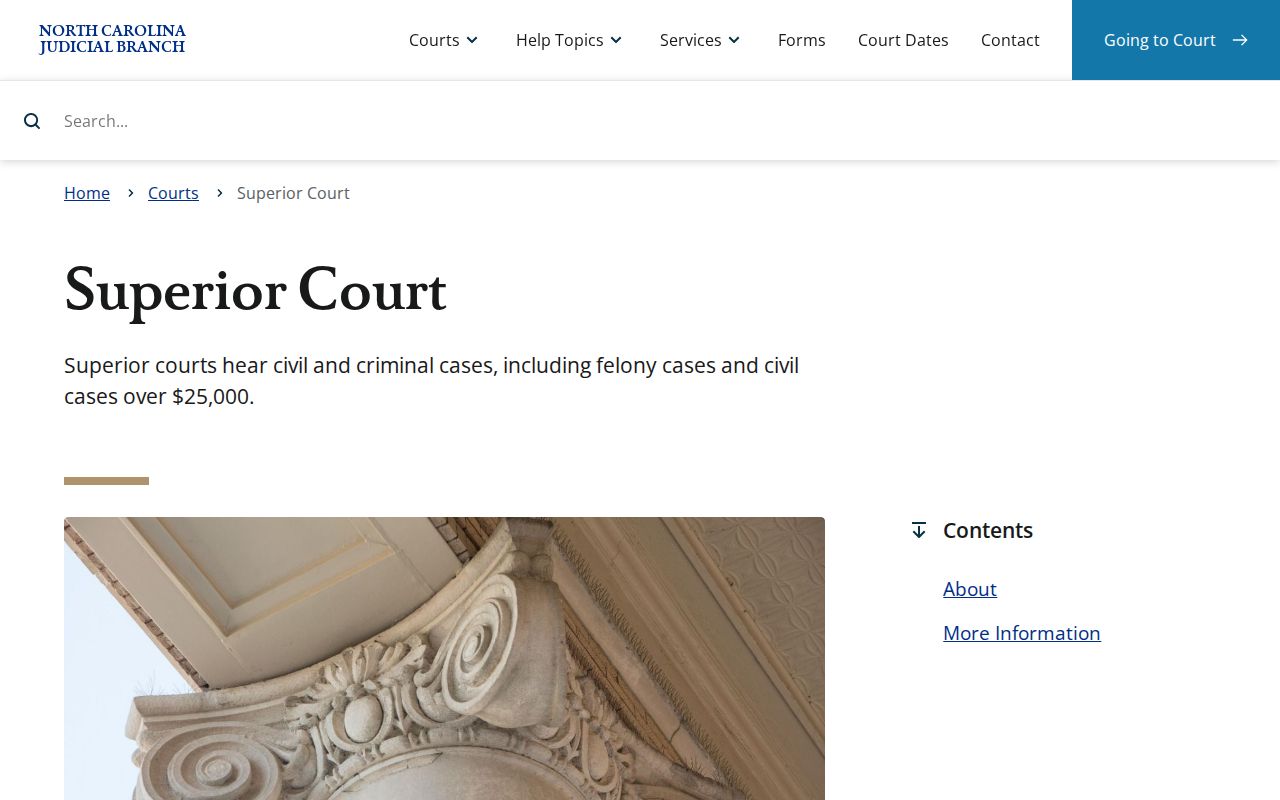
The division and rotation system affect where judges serve, while the filing county determines custody of the record.
North Carolina Trial Jurisdiction
Subject matter, severity, and the amount in controversy direct a matter to the proper trial division. Superior Court handles felonies and higher-value civil disputes. District Court handles misdemeanors, infractions, traffic, family, juvenile, and civil matters at or below the statutory threshold. Magistrates perform narrower District Court duties. The clerk's probate authority is separate from the clerk's administrative custody of all trial files.
| Superior Court | District Court | Magistrate | |
|---|---|---|---|
| Civil jurisdiction | Over $25,000 | $25,000 or less | Generally up to $10,000, subject to a lower local limit |
| Criminal jurisdiction | Felonies | Misdemeanors, infractions, traffic, and preliminary felony matters | Warrants, initial appearances, release conditions, and certain waivers or pleas |
| Family and juvenile | Limited by assigned jurisdiction | Divorce, custody, support, domestic violence, and juvenile cases | No general family trial jurisdiction; magistrates may perform marriages |
| Typical next review | Court of Appeals or direct route set by law | Superior Court de novo for specified matters or Court of Appeals as provided | District Court trial de novo where authorized |
North Carolina Case and Appeal Paths
A criminal matter can begin with a citation, magistrate's order, or warrant. District Court handles misdemeanors and preliminary felony stages. A grand jury indictment normally moves a felony to Superior Court. A civil action begins with a complaint and summons in the proper county, and its subject and value determine the trial division. Appellate courts then review preserved legal issues on the record, except where a statute grants a new trial at the next level.
Felony flow: Charging process › Magistrate and initial appearance › District Court preliminary stage › Grand jury indictment › Superior Court plea or trial › Judgment › Court of Appeals › Supreme Court review where available
Civil flow: Complaint and summons › District or Superior Court › Motions and trial › Judgment › Court of Appeals › Supreme Court review where accepted or allowed
Small claims flow: Magistrate complaint › Hearing and judgment › District Court trial de novo › Later review under applicable procedure
North Carolina District Court Division
District Court carries the high-volume misdemeanor, infraction, traffic, family, juvenile, and lower-value civil docket. Civil jurisdiction generally covers claims of $25,000 or less. Domestic work includes divorce, custody, support, and protective orders. Juvenile delinquency and abuse, neglect, or dependency matters also belong here, but their files receive special confidentiality protection.
North Carolina has no municipal-court layer. City ordinance and ordinary traffic prosecutions proceed in District Court. Family Court programs may coordinate domestic matters in participating districts, and Recovery Courts may use supervised treatment models, yet these programs do not create independent local court systems.
The official District Court description is represented below.
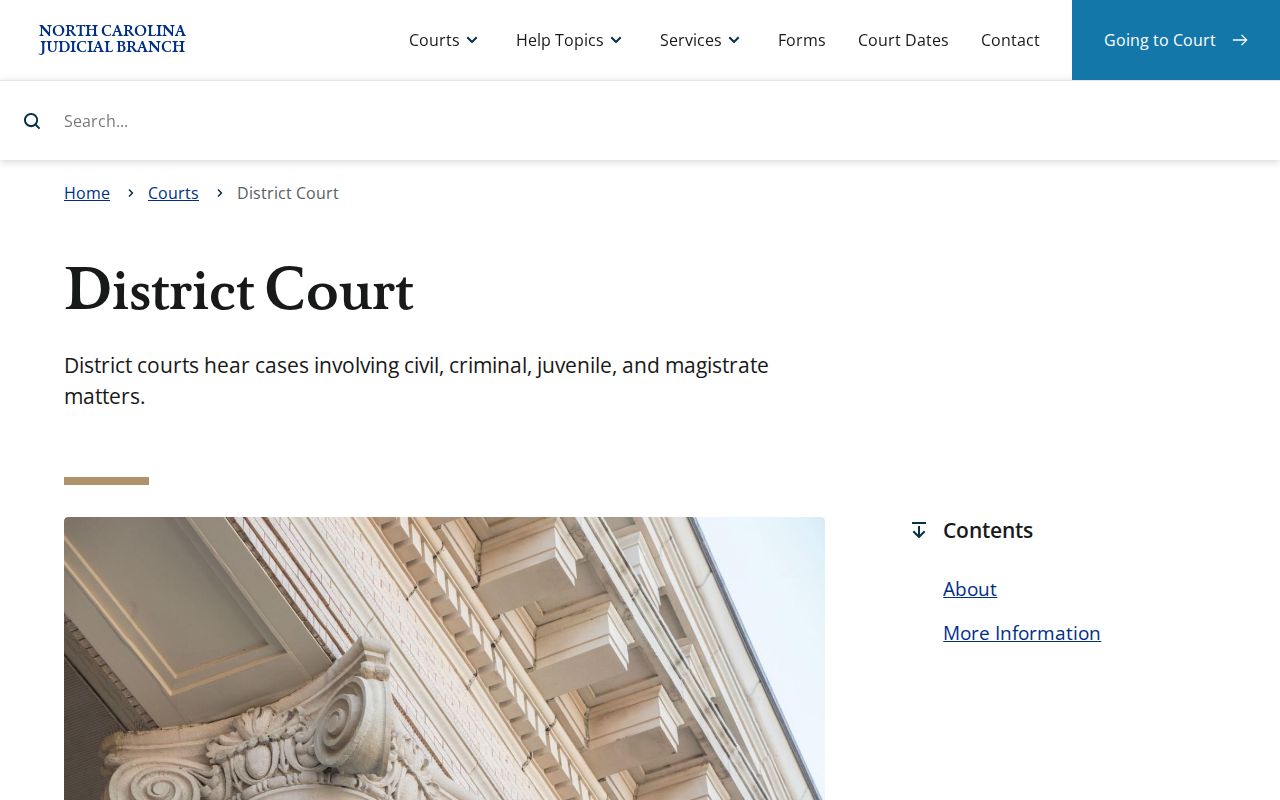
The statewide division can use local administrative programs while retaining common jurisdiction and record custody rules.
North Carolina Magistrates and Clerks
Magistrates are District Court judicial officers. They issue arrest and search warrants, conduct initial appearances, set many release conditions, accept certain waivers and guilty pleas, perform marriages, and decide small claims without a jury. The usual small-claims ceiling is $10,000, although a chief district judge may set a lower local limit. A timely appeal can lead to a new District Court trial.
The elected Clerk of Superior Court also acts as judge of probate. That office handles wills, estates, guardianships, trusts, foreclosure, partition, adoptions, and other proceedings within statutory authority. Judicial review or transfer applies as the governing procedure requires. This clerk-centered probate role is a distinctive part of the North Carolina court system.
Federal Courts in North Carolina
Federal jurisdiction is separate. The Eastern District, Middle District, and Western District hear federal crimes, qualifying constitutional and civil-rights suits, diversity matters, and other cases Congress assigns. They do not serve as appellate courts for ordinary state judgments. Appeals from all three go to the Fourth Circuit. Federal case records use PACER, not North Carolina eCourts Portal.
The statewide official court directory gives another view of the available court levels.
Review the official North Carolina courts directory.
That directory includes the appellate and trial divisions as well as specialty programs within the unified judiciary.
North Carolina Court System History
Superior Courts date to 1777 and are the state's oldest courts. Later constitutional and legislative reforms replaced a fragmented structure with the unified General Court of Justice. The Court of Appeals was created in 1967 as caseload growth called for an intermediate review layer. Counties still provide filing places and facilities, but the court organization, forms, administration, and base fees are statewide.
The official structure explanation is shown in the next image.
Read the North Carolina Judicial Branch court structure overview.
The modern structure combines central administration with local county filing and custody.
Find North Carolina Trial Courts
Trial files, dockets, and certified copies remain with the Clerk of Superior Court in the filing county. Browse the directory of all 100 North Carolina counties to reach the correct local site and official office information. The North Carolina court records page explains statewide Portal search, public terminals, county requests, certification, and restricted records.
Use the county named in the case header rather than a party's current address. A transferred matter may have entries in more than one location, and the original docket can document the movement. For federal litigation, select the correct district through its official jurisdiction page because federal boundaries do not match the state Superior Court districts.